Notes and photos of my visit to Ireland, 2025
9 October to 3 November
After several days in Dublin, I drove out to west Kerry to explore the area where Tomás Rua Ó Súilleabháin lived, wrote, played, danced, and taught and to see if I might find any presence of him on the ground today. Tomás was an early nineteenth century poet and hedge-schoolmaster of the Iveragh Peninsula (more commonly known as the Ring of Kerry) and remembered today for numerous songs, perhaps the most widely sung being Amhrán na Leabháir, The Song of the Books. (HERE is my rendition.) In 1835 he was moving from Darrynane in the southern part of the peninsula to Portmagee in the north to be a schoolmaster there. Since the only “road” was steep and rocky, he put all his possessions, including his library of hundreds of leather-bound books in Hebrew, Greek, Latin, and Irish on a boat and then set off on foot on the Butter Road toward his new home. When he got to Portmagee he was told that all his possessions were lost to shipwreck. He poured his grief into his lament for the lost books, which is frequently sung today, almost 200 years later.
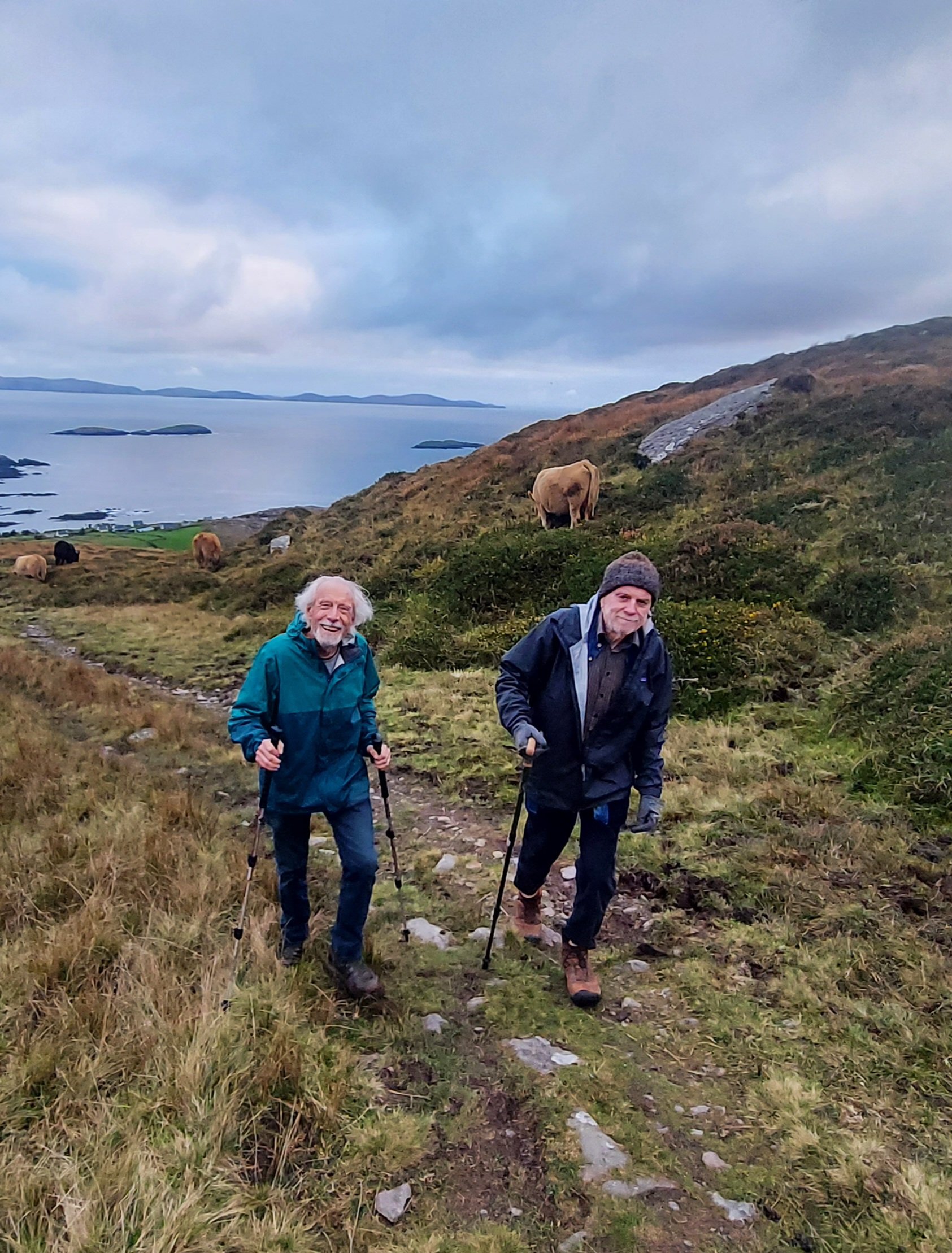
Here I am on the Butter Road (that goes to the Cork Butter Market) with a friend of my host, Paddy Bushe. This is the road Tomás walked almost two hundred years ago as his library was lost to shipwreck in the bay behind us.
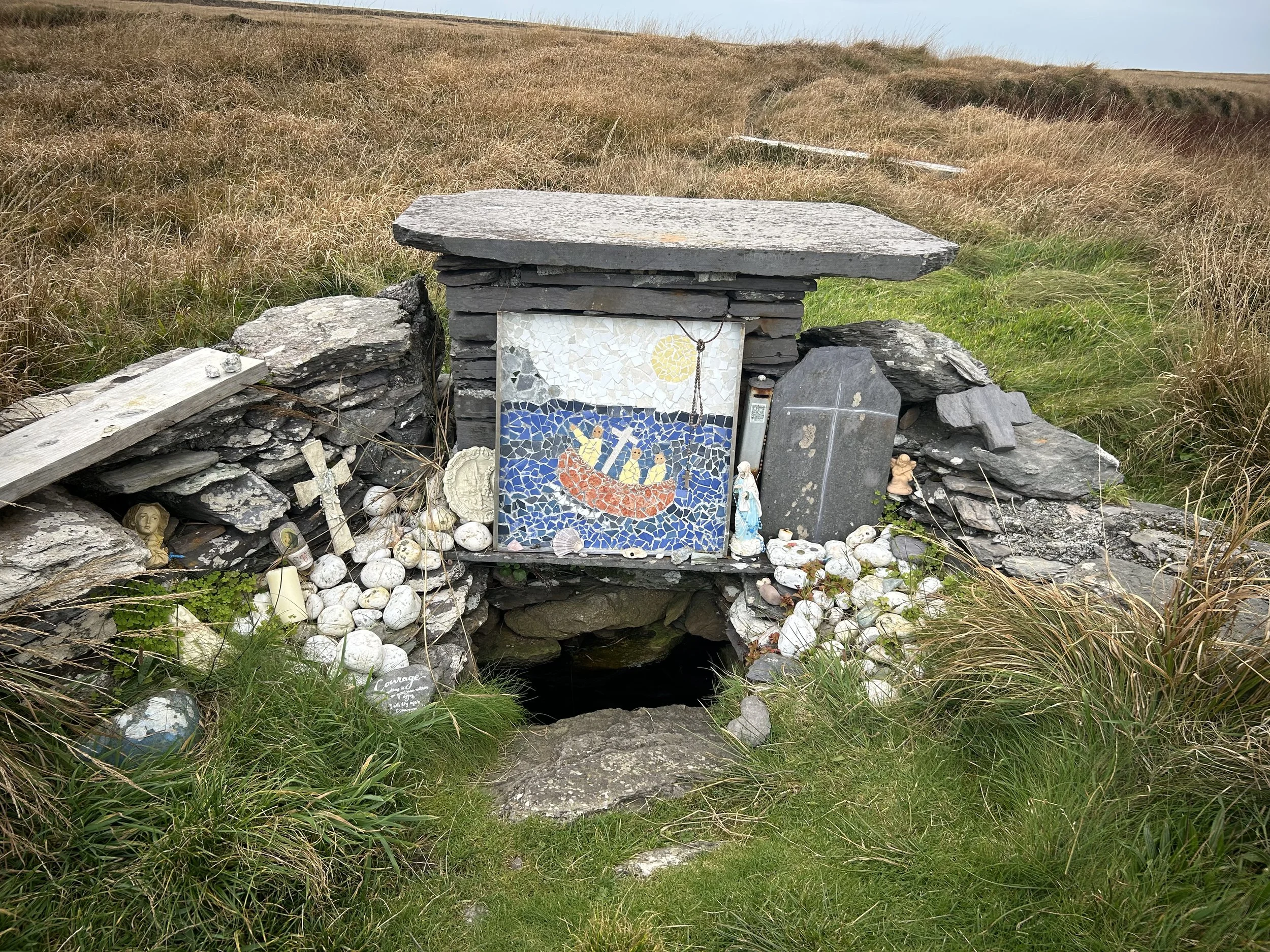
St. Brandan’s Well on Valencia Island. Notice the mosaic of Brendan, The Navigator, taking his disciples across the North Atlantic, possibly as far as Labrador. Leave a token when you visit or add your own stone scratches to the cross on the slate.
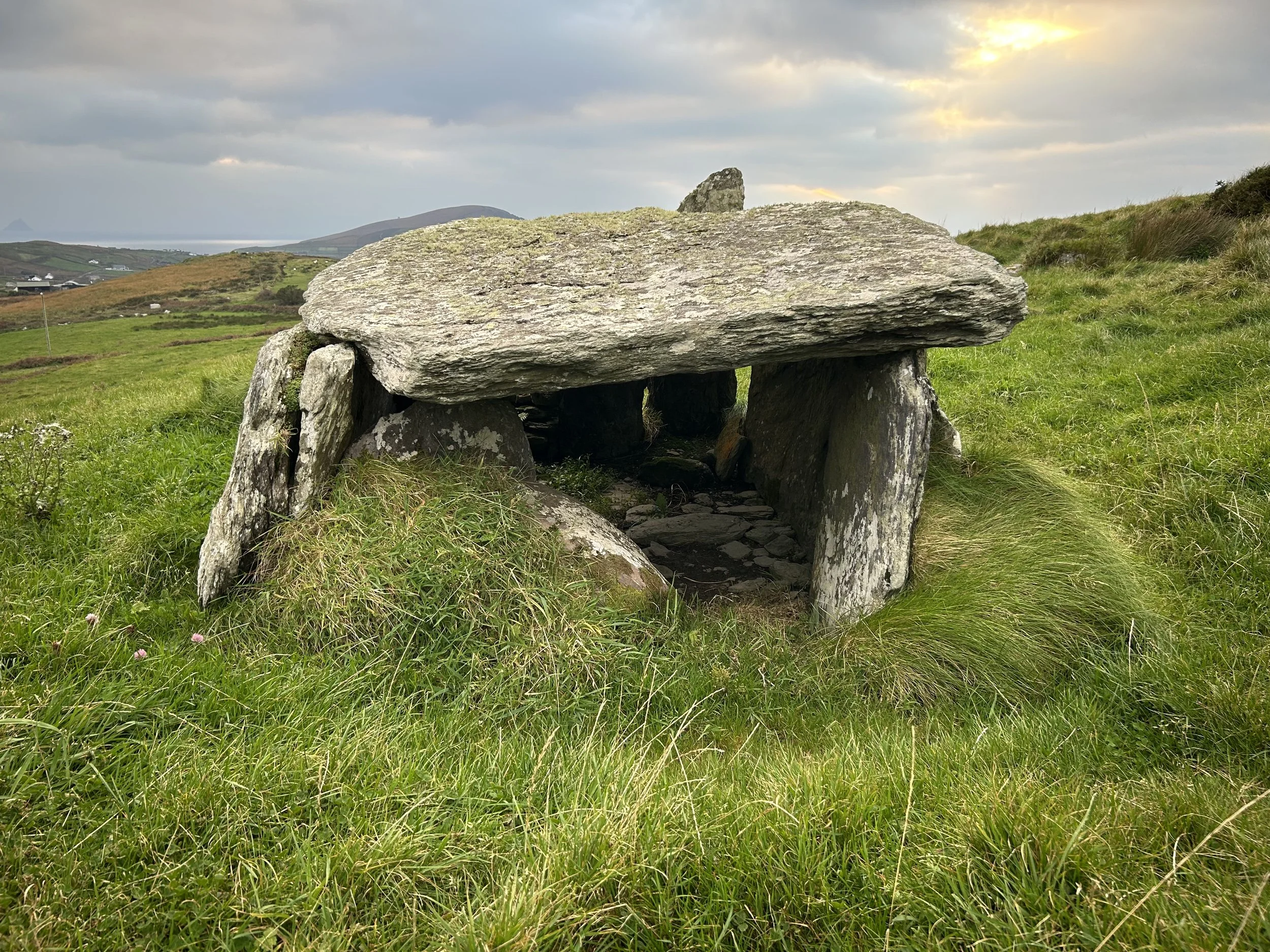
A neolithic or Bronze Age passage tomb in the middle of a pasture, one of probably hundreds throughout Ireland. This one is known as the Cool East Wedge Tomb. Cúil is Irish for corner or nook and is the name of the townland in which this was constructed thousands of years before the townland existed.
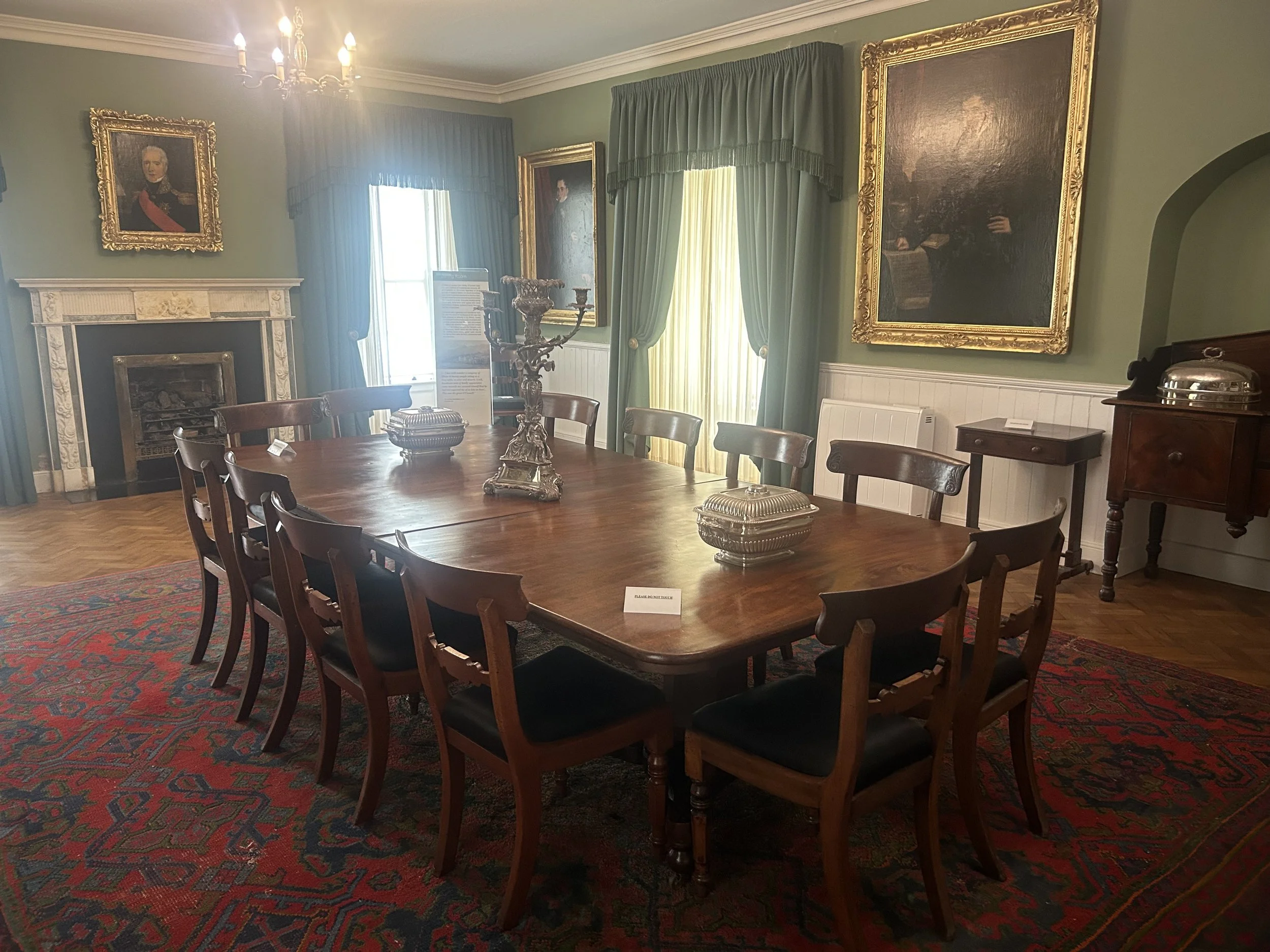
I visited the ancestral home (now a museum) of Daniel O’Connell, known as the “Liberator” for his ultimately successful campaign to convince the English Parliament to rescind the many age-old Penal Laws (which essentially outlawed Roman Catholicism), which it did in 1829. Here is his dining table where he entertained both dignitaries and commoners with his unstinting hospitality.
My last stop on the west coast was in Bantry, Co. Cork, to visit Bantry House, the palatial residence and extensive formal Italian gardens of the White family, the area’s chief Protestant landlord. I don’t usually stop for tourist destinations like that but this house is implicated in stories about one of the songs I sing, Cath Chéim an Fhia, the name of the mountain pass between Bantry and the valley of the River Lee to the east. The song is about a battle between the White Boys (no relation to the landlord but rather agrarian rebels who sometimes painted their faces white) and a Yeomen troop from Bantry House that happened at that mountain pass. One of the stories about the lead-up to the battle is that some of the White Boys from Ballingeary (in the Lee valley) had raided Bantry House for guns and the attack by the Yeomen was in reprisal. The historian/docent at Bantry House said that there is no documentary evidence of that raid for guns but that that didn’t mean it didn’t happen. It might just have been advantageous for Lord Bantry not to report it and might have been too embarrassing to even mention it in his diaries. We don’t know if the story is true but it is part of the folk history of the area.
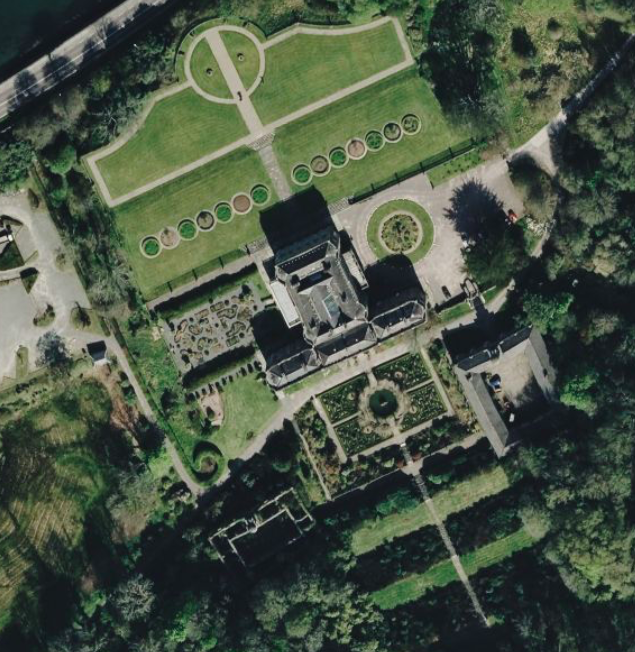
Bantry House from above with the three black squares visually dominating the scene. They are the shadows of the two servants’ quarters and the larger main house. The extensive formal Italian gardens can be seen on all sides.
After attending the wonderful singing session in Cork City at the Spailpín Fánach, I headed toward Belfast where I performed a set as the guest artist at the Sunflower Folk Club. What an honour to be asked (and paid) to sing Irish songs to Irish song lovers!
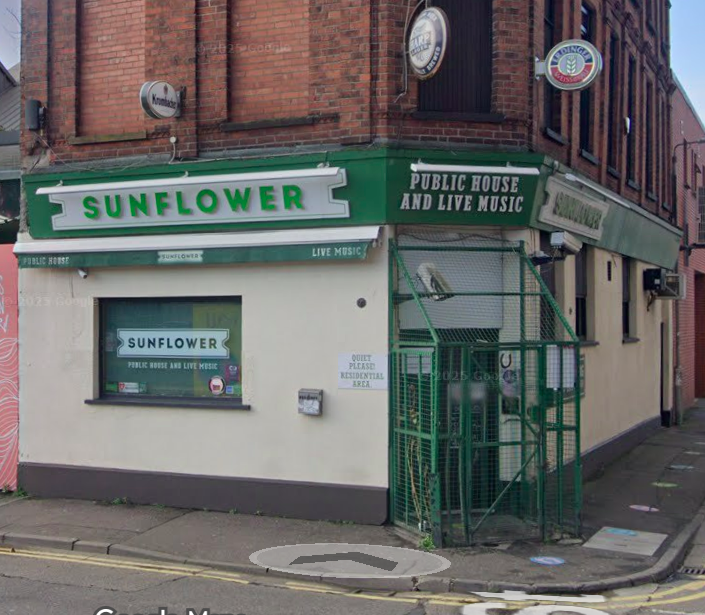
The Sunflower Pub might be the only business in Belfast that still has their bomb-proof security cage left over from the Troubles in the 70s and 80s.
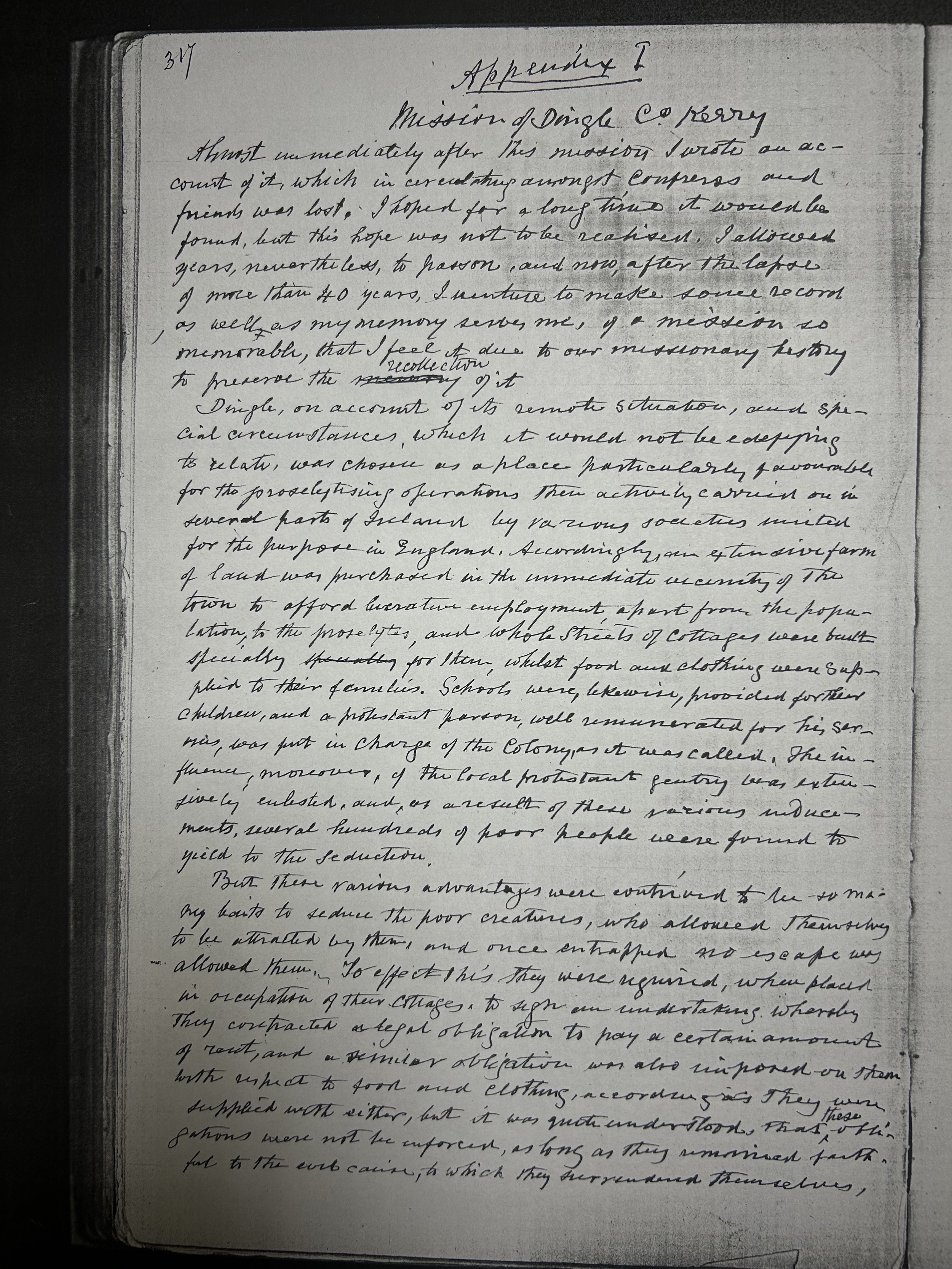
A sample page—one of hundreds—of the unpublished A Memoir of the Congregation of the Mission in Ireland, England, and Scotland by Thomas McNamara, ca. 1865. I’ll explain more about my purposes in doing this research at another time.
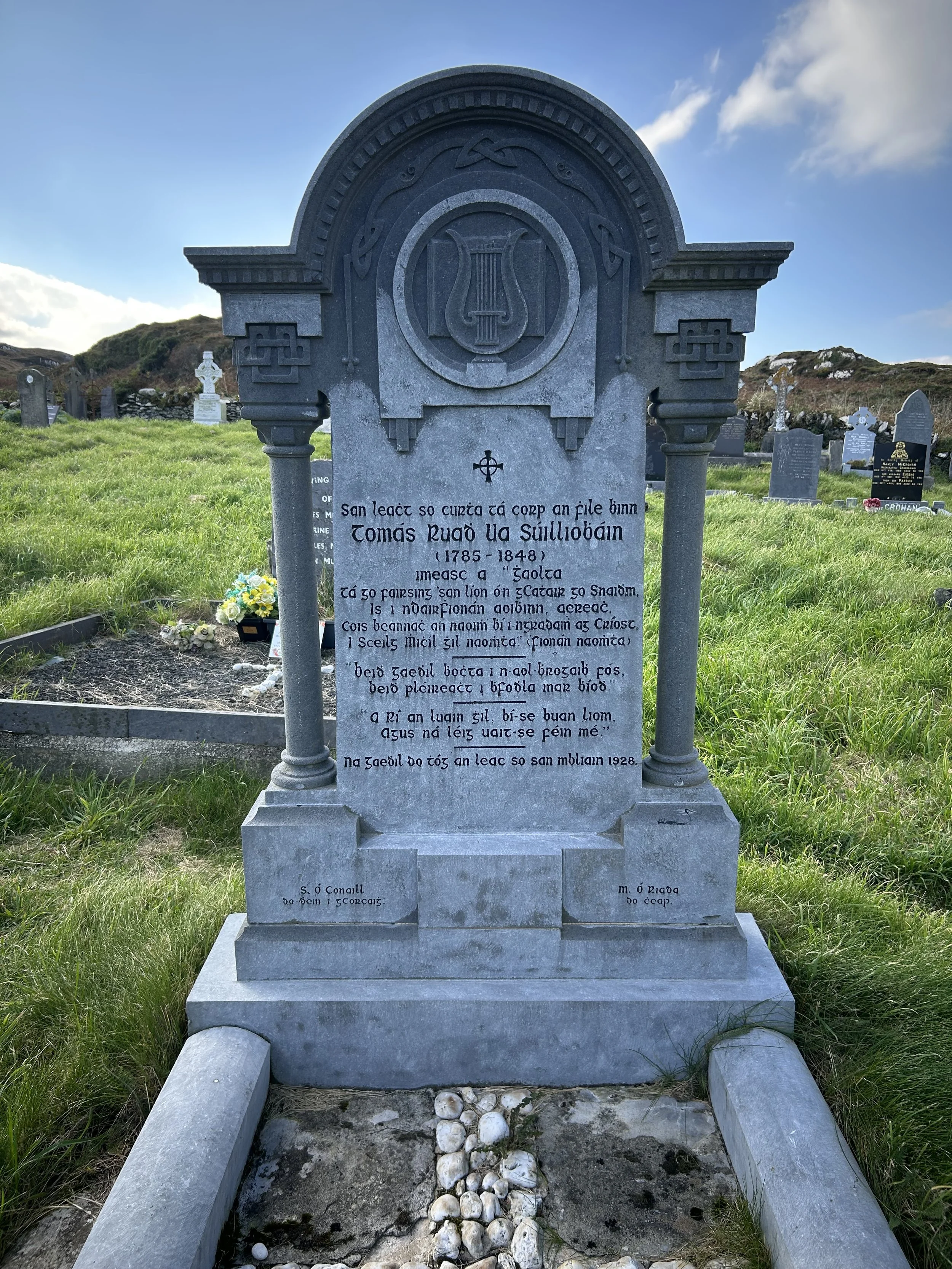
A modern (early 20th century) memorial for Tomás (d. 1848) on Abbey Island.
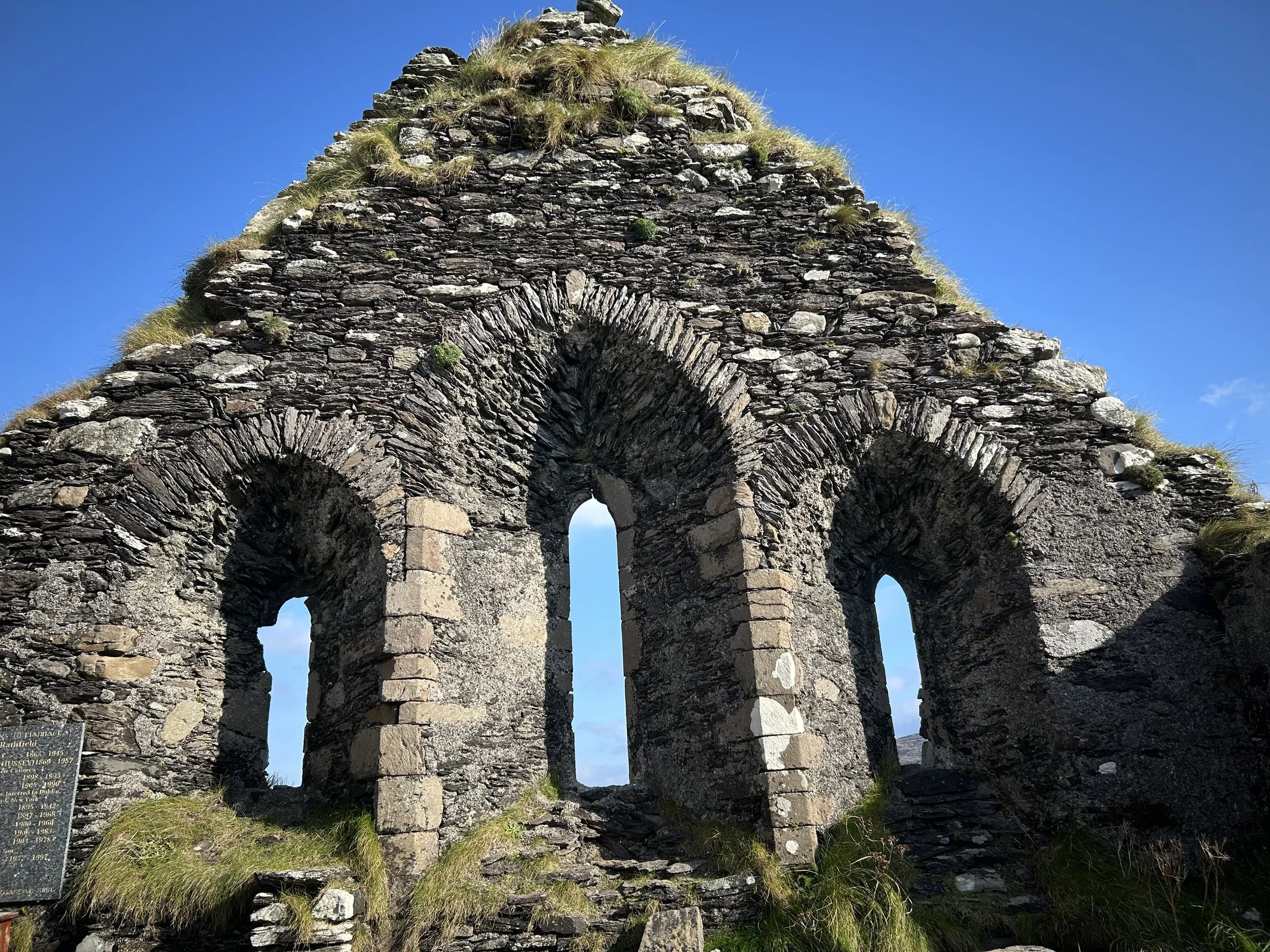
Darrynane (Doire Fhíonán or St. Finan’s woods) Abbey, the remains of the church gable, believed to date from the seventh century. On Abbey Island.
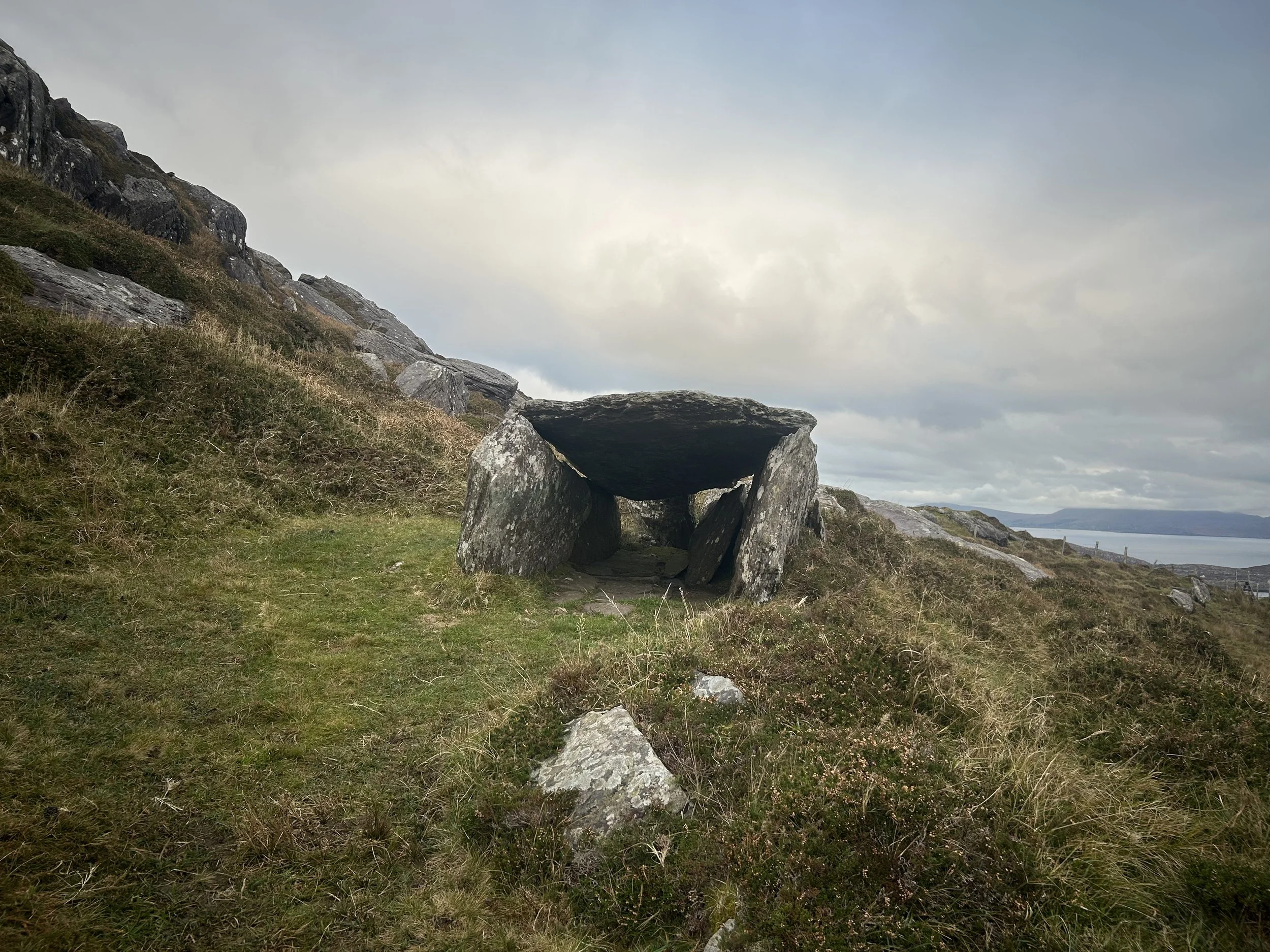
Here’s another Bronze Age passage tomb at the edge of the Butter Road near the pass at Coomakiste which Tomás would have passed on his way to Portmagee.
I spent a fascinating day out on Valencia Island (now connected by a causeway to Portmagee on the mainland). Right next to a monument marking the landing of the first Transatlantic Telegraph Cable in 1858 there happened to be a crossroads stage. I had always known that crossroads dances were common (and commonly frowned on by the local parish priest) up until the middle of the 20th century. I hadn’t known that stages were frequently built specifically for those dances at selected crossroads, sometimes out of wood, this one of flags (flagstones). I also visited St. Brendan’s Well and spent a lot of time trying to get over fences and walls and through brambles and boggy ground to visit a stone age passage tomb in the middle of a farmer’s pasture.
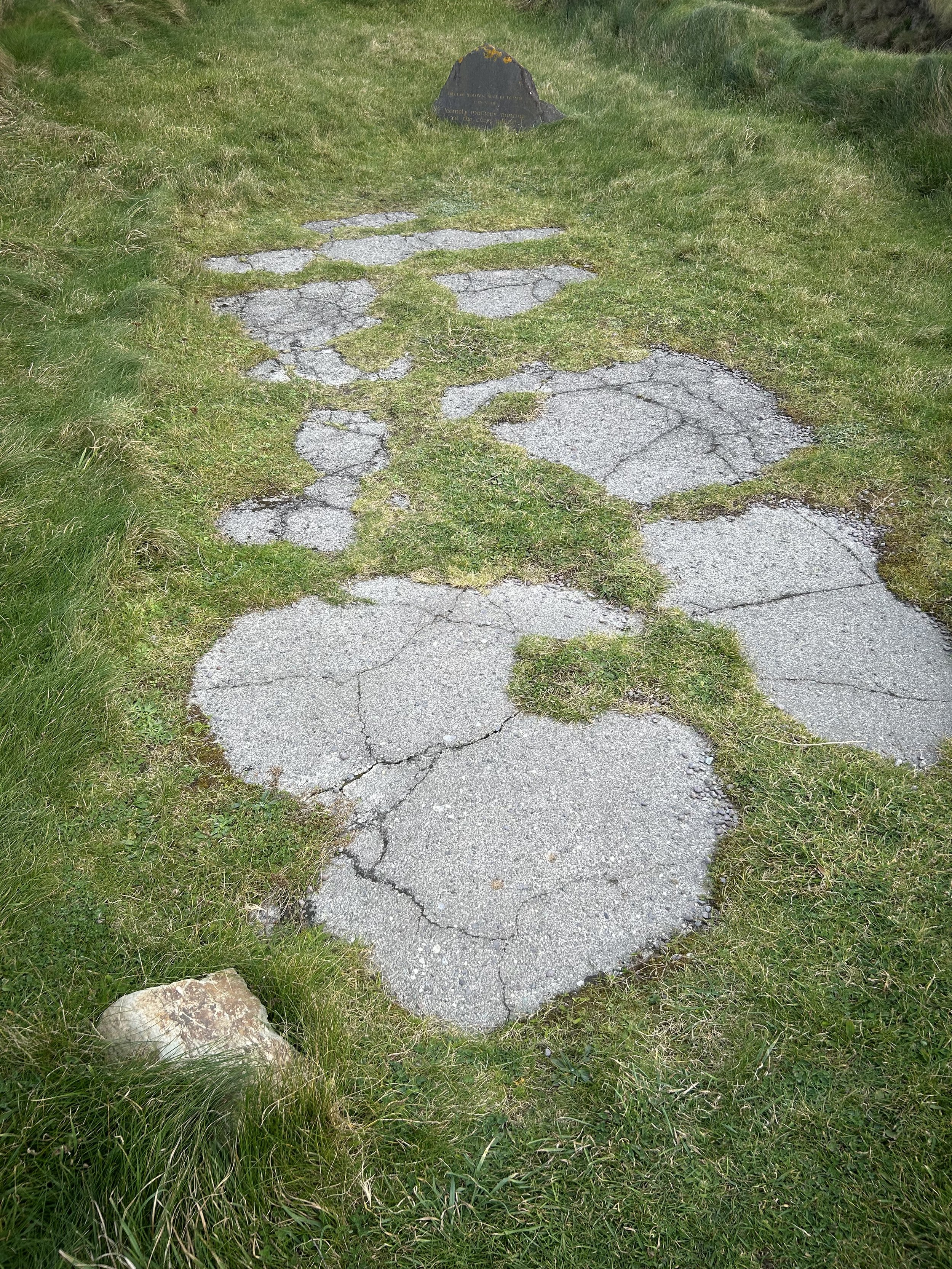
The remains of a crossroads dance stage on Valencia Island.
One last stop on the Iveragh Peninsula: a visit to the Staigue Stone Fort, built during the late Iron Age, about 1700 years ago. It is in amazingly good condition, especially considering it was built with undressed stones and with no mortar. It is assumed to have been the fortress and dwelling of a significant local chieftain.
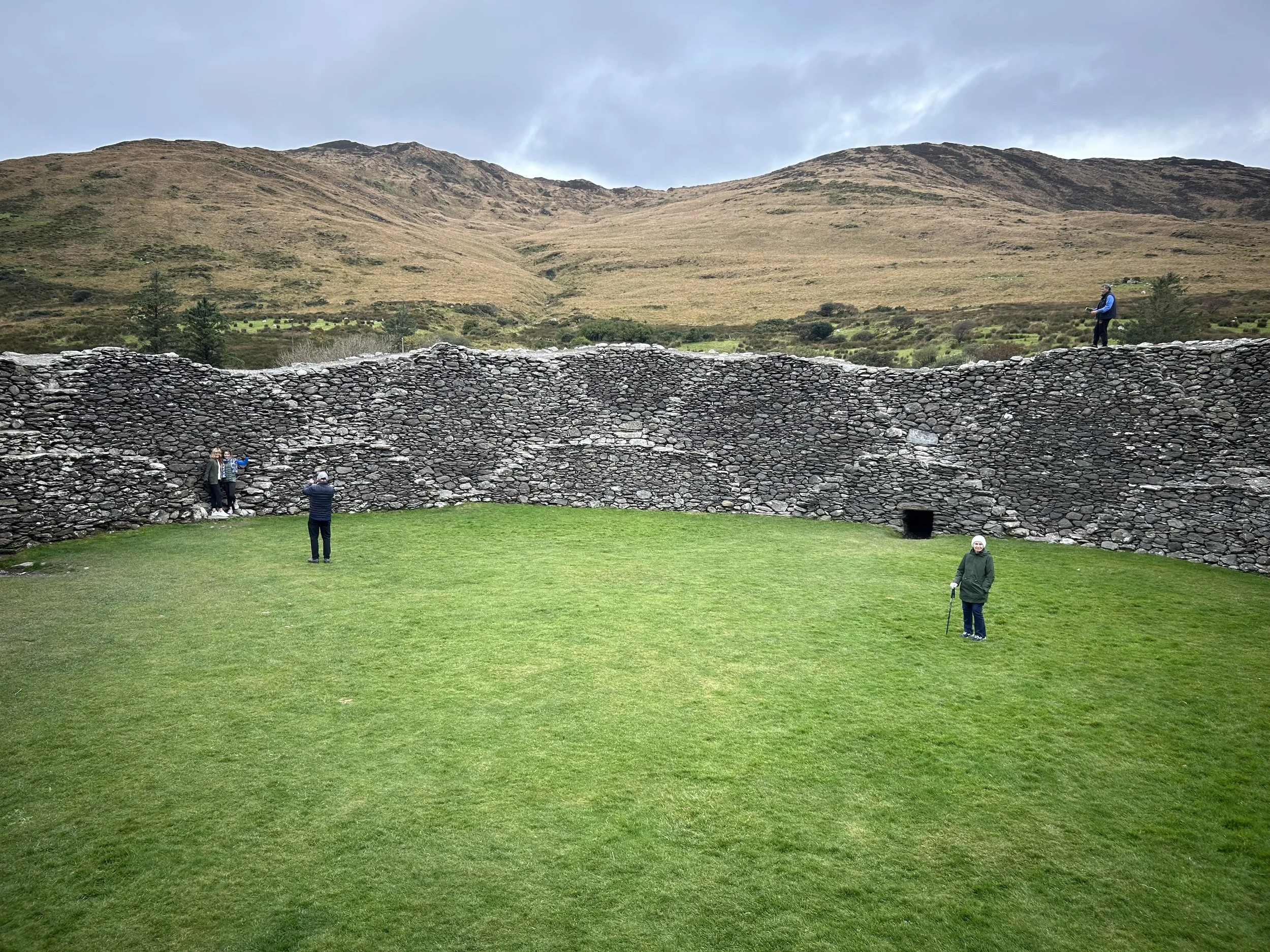
Note the lower stairs leading up to defensive positions as well as the upper stairs leading to the top of the wall for offensive or peacetime purposes.
After leaving Bantry, I stopped to see another megalithic stone structure, this one a stone circle aligned with the setting sun on the midwinter solstice. Radiocarbon dating suggests that the structure, which we call Drombeg Stone Circle, was actively used for about three hundred years about 3,000 years ago. Notice that what we call the first day of winter is called midwinter in the Celtic calendar, their winter starting on November 1 and ending February 1.
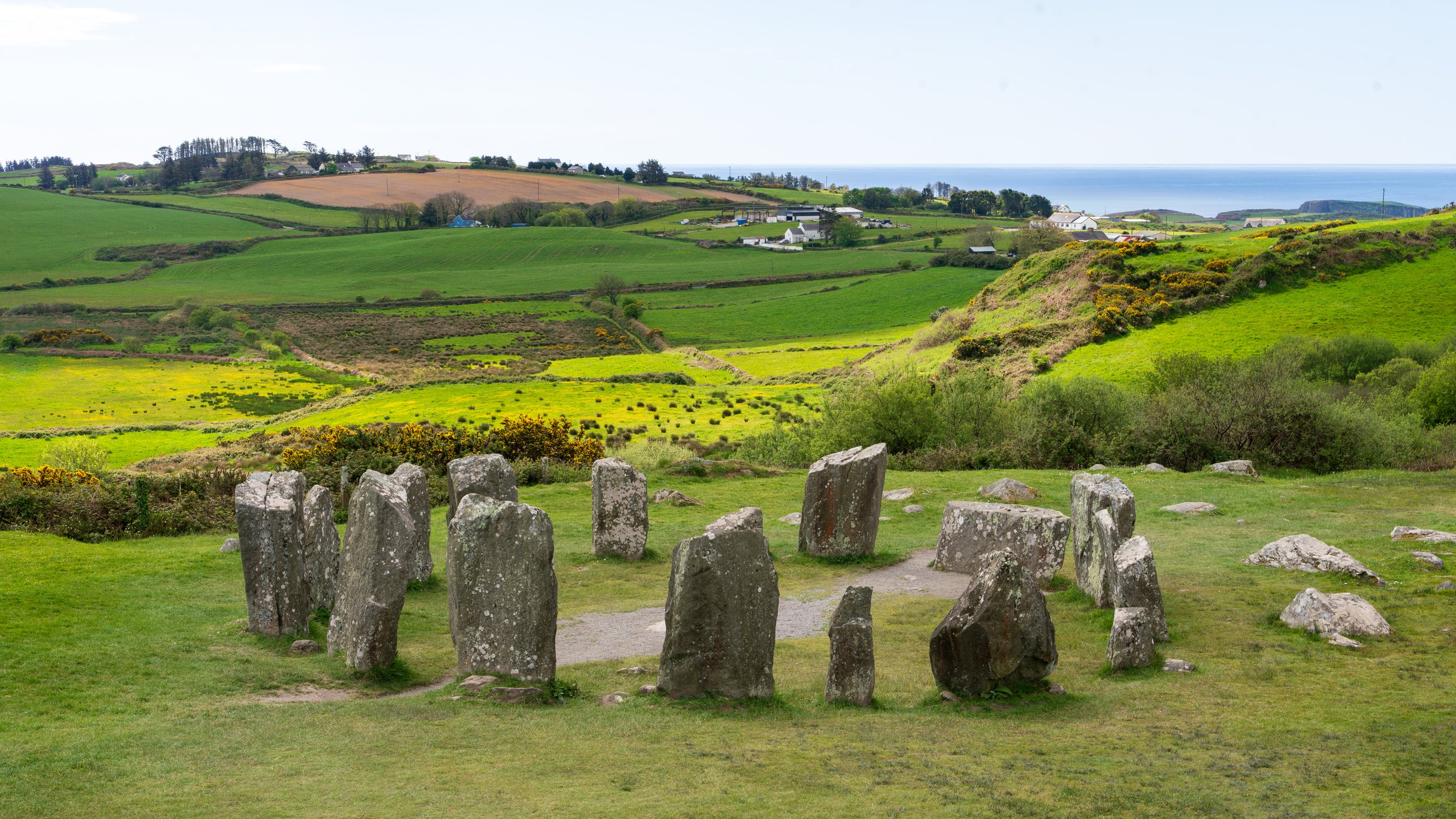
Drombeg Stone Circle, photo by David Kernan, from Wikipedia, a better shot than any of mine.
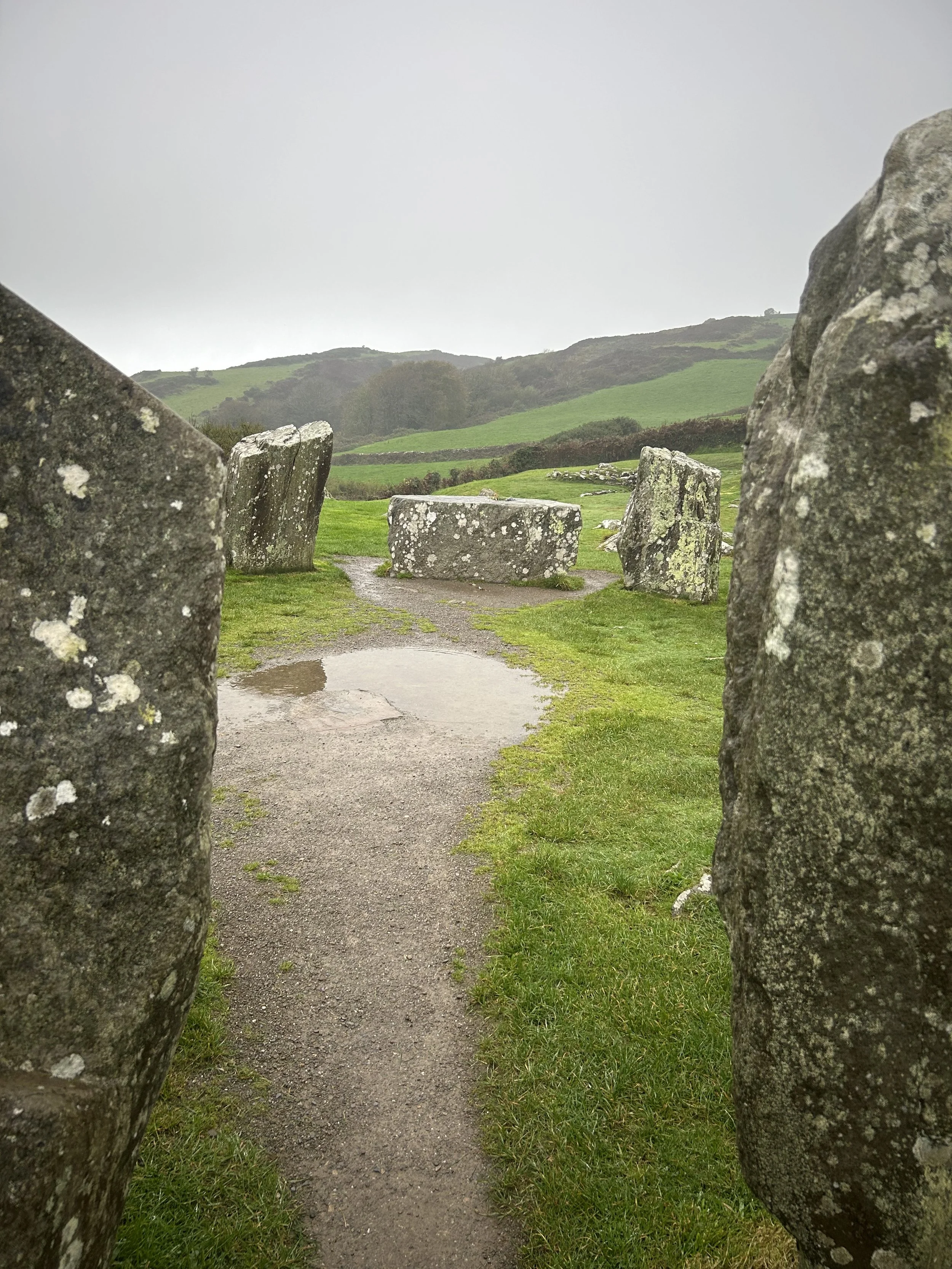
My own shot on a rainy October day looking through the portal stones toward the recumbent stone (or possible altar) at the far side of the circle. On December 21 the setting sun would be directly over its center. When it was excavated about 70 years ago a pot was found buried in the center of the circle. It contained the remains of a cremated young adolescent wrapped in a thick cloth.
The last week of my visit I spent in Dublin, much of the time at the Vincentian archive, reading and taking photos of two handwritten documents (books, really—hundreds of pages) which have never been published. They were written in the 1860s about (at least partly about) the Protestant evangelism in the 1840s on the Dingle peninsula and the Roman Catholic response to it, mostly in the form of St. Vincent de Paul missioners sent to fortify the local Catholic population and reclaim some of the souls they had lost. I also went to the Quaker Library and Archive in Dublin hoping to find a journal written by a Quaker during the situation on Dingle during the 1840s (the latter half of which was complicated by the Great Hunger, the so-called Potato Famine.) No such journal seems to exist.
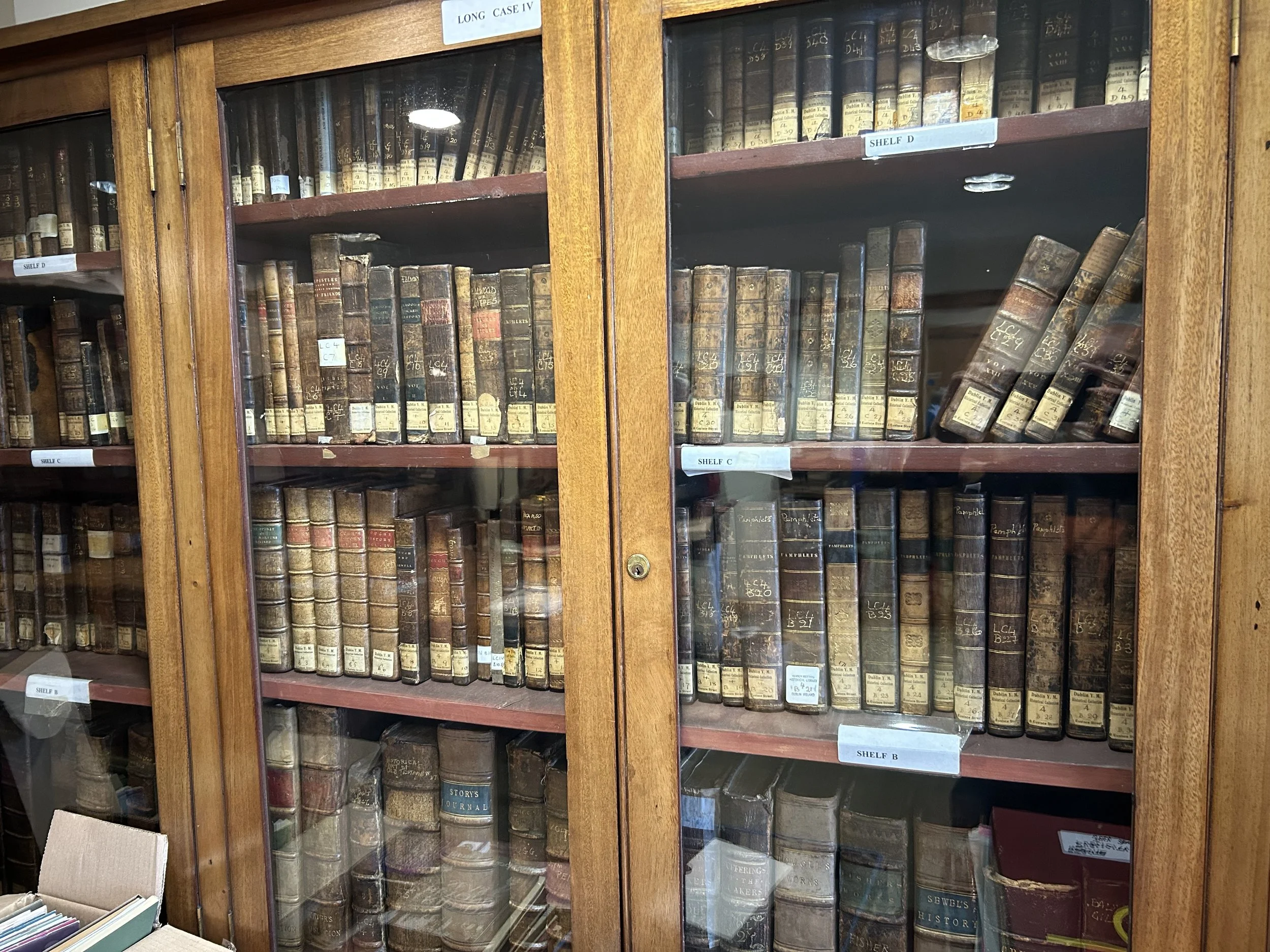
Some of the many shelves of old books and document collections in the Quaker Archive.
Those were the highlights of my trip to Ireland in 2025. I usually zip around the country attending as many singing sessions as I can but this time sang or told stories from Irish mythology in only six sessions and told a story in one storytelling session. I spent a lot more time doing the field research about Tomás (mentioned above) and about the 1840s in Dingle. Rather different but still a wonderfully inspiring and memorable visit to Ireland.
Notes and photos of my visit to Ireland, 2023
27 to 30 April
The last four days of this year’s trip to Ireland I spent in Dublin. I visited the Irish Traditional Music Archive and made arrangements to contribute my information about “Smiling Aghadoe,” the more than one hundred year old song I discovered had never been collected or published. (See the story HERE.) The very helpful librarian, Róisín Conlon, also helped me find information about the singing styles employed by the ballad mongers of the nineteenth and early twentieth centuries. Then I went to the Teachers’ Club where An Góilín Traditional Singers meet every Friday evening in a beautiful chandeliered room. I was honoured to be the guest artist for the session and sang nine well-received songs, putting an exclamation mark at the end of my trip.

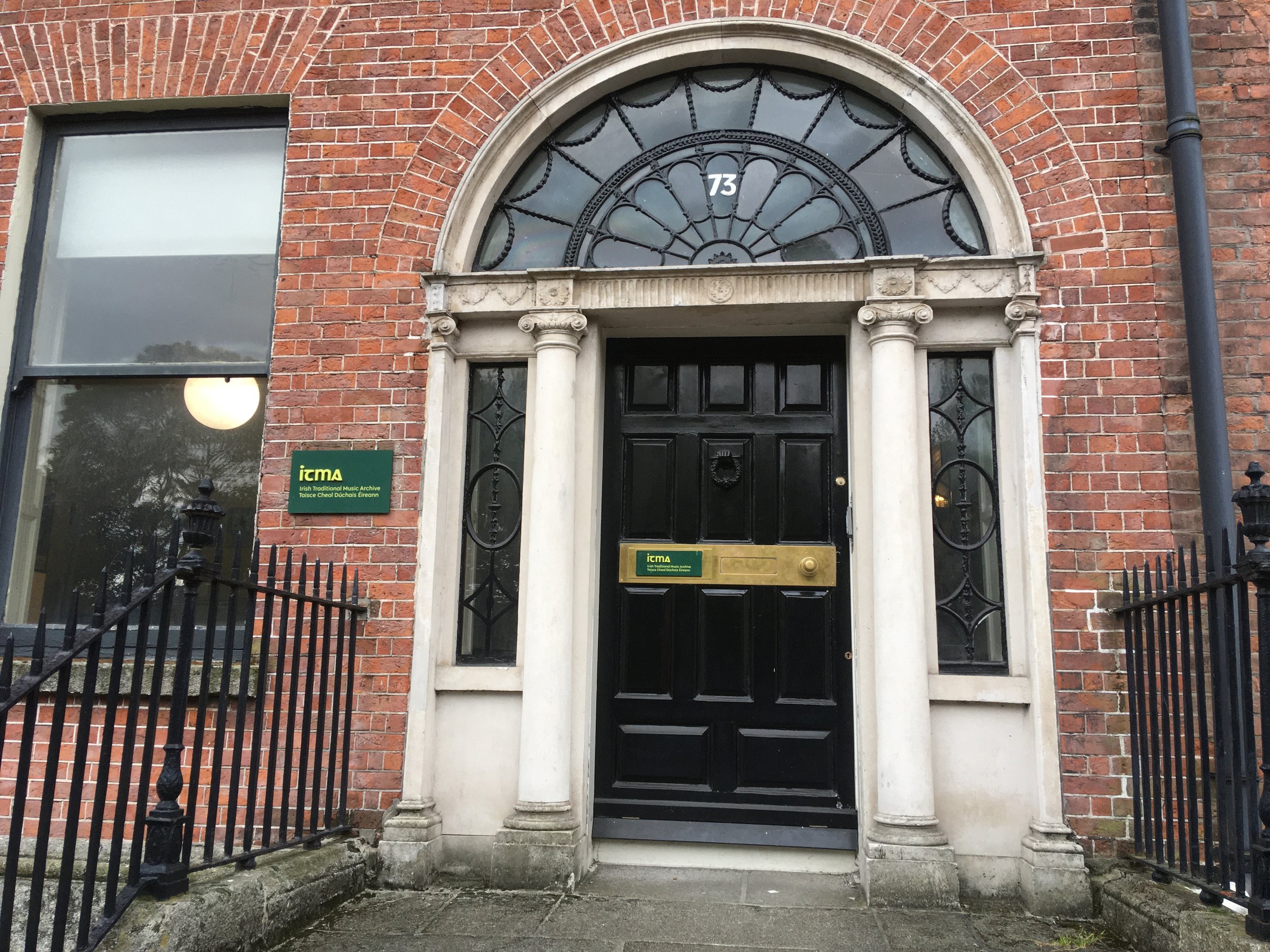
The front entrance to the Irish Traditional Music Archive, which is in a beautiful old Georgian house.


The chandeliered and gold-decorated ceiling of the room in the Teachers’ Club where the traditional singers meet every Friday evening.
23 to 26 April, 2023
I spent several days in the beautiful Glenfarne Valley, Co. Leitrim, where I had the honour of being the guest artist at Rosie Stewart’s Rainbow Singing Club session in McHugh’s. The name of the valley is actually redundant, for Glen already means valley. The farne part is actually fearn in Irish and means alder. Hence, Alder Valley. Unfortunately for its name, the forestry plantations on the opposite hillside are all coniferous and none of them alder.


My first pint was on the house because “It’s your first time here.” I understand that on major holidays your first pint is free for everyone. Savvy marketing!
19 to 22 April
My mountain in Ireland this year was Croagh Patrick, with a 2500 foot summit overlooking Clew Bay. Yes, by Oregon standards it’s just a hill but I’ll tell you it’s one of the most difficult climbs I’ve ever done. The last half of the ascent is unrelentingly steep, among the steepest I’ve ever attempted. I almost gave up at one point—the wind was also unrelenting and frequently unbalancing—but then looked at Google Maps on my phone (connectivity is amazing in Ireland!) and saw that I was less than 300 yards from the top! A little rest was all I had needed. I asked the two hundred or more people I met going up and down where they were from. I got fascinating results, summarized here: 14 countries represented; 18 of the 32 counties in Ireland; 7 states of the US. I’ll put the details up later.

Bust of John MacBride, a local hero of the War of Independence. He was executed by the English in 1916. To the right is the view from the top looking north over Clew Bay with its scores of little islands.


View of the summit from half way up. To the right is the view of Croagh Patrick from across part of Clew Bay. The little blip at the summit (a little to the right of what appears to be the summit from this angle) is Teampall Phádraig, Patrick’s Oratory

11 to 18 April, 2023
While in Drogheda I drove a little ways up the Boyne River valley which is rich in historical sites and ruins, from five thousand years ago (Newgrange, Knowth, and Dowth) through pre-Christian remains (Tara) to Medieval and more modern events. I visited the site of the Battle of the Boyne (1690), the start of the Williamite Wars which resulted in William of Orange taking over the monarchy of the English Empire and solidifying Protestant power. Then I visited the ruins of Mellifont Abbey, established in 1142 by the Cistercians, an extremely strict order originating in France. It housed up to 500 religious and lay brothers at its height in the thirteenth century. It’s rise resulted in the demise of the next place I visited, Monasterboice, which was established by St. Buithe in the sixth century and is famous for its three tenth century high crosses and round tower.
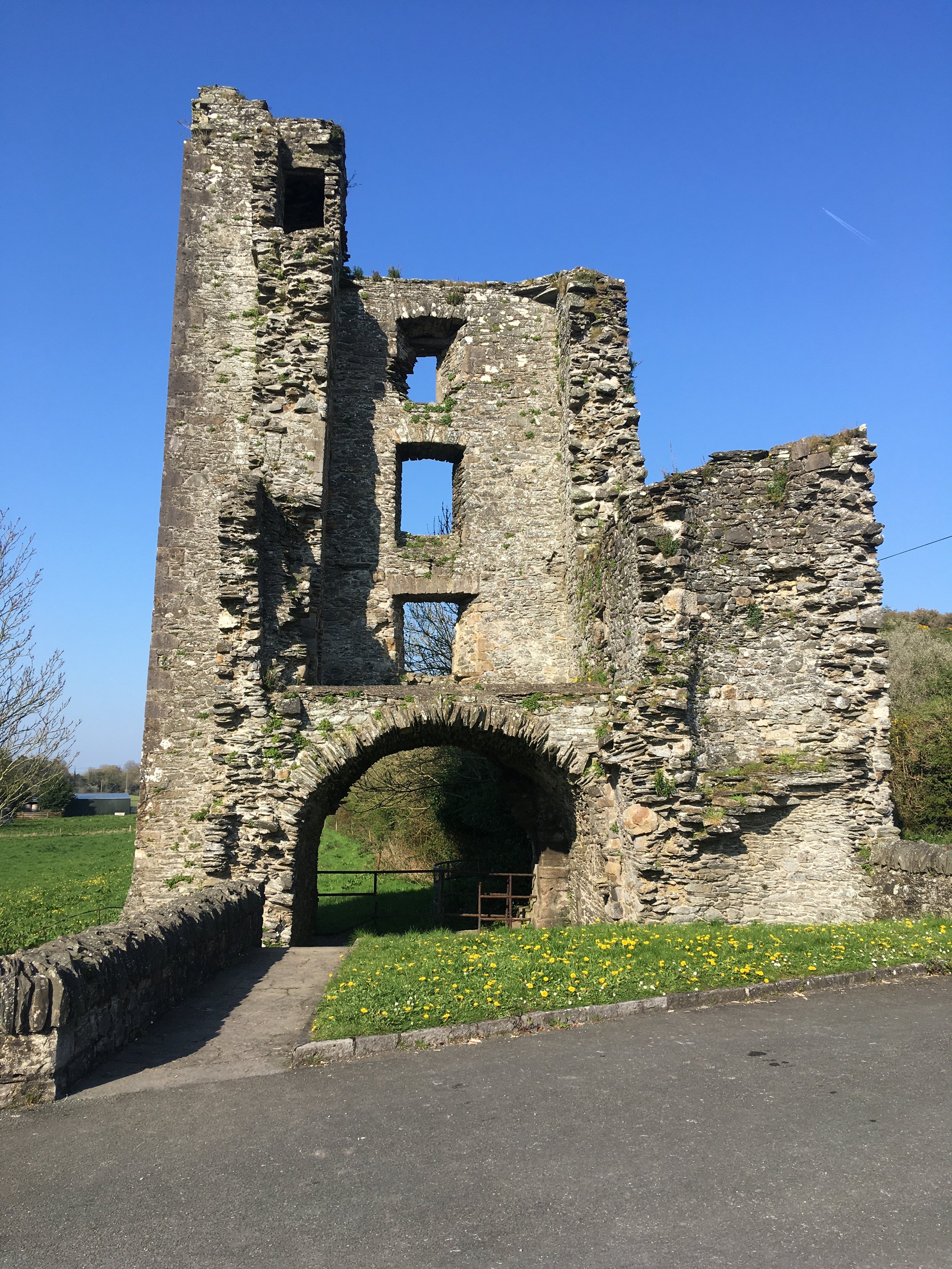
A remnant of the gate of the outer defensive wall of Mellifont Abbey.

Threatening-looking but effectively constructed arched passageway at Mellifont Abbey.

The Monasterboice round tower—110 feel tall—built in the tenth century as a defense against Viking raids. It is missing its conical top but is otherwise in excellent condition.

Cannon at the Battle of the Boyne Visitors’ Center.

Detail of the remaining cloister at Mellifont Abbey.

One of the three tenth century high crosses at Monasterboice with Biblical scenes carved into the upright.


Mellifont Abbey ruins. Most of the old buildings were torn down for their valuable building materials. Much of what we see is the excavated remains.

Part of the Lavabo (at Mellifont Abbey) where the monks “purified” themselves with water.

Another of the early high cross at Monasterboice.

After a brief visit to Dublin to hear my friend Libby Healy singing—wonderful, inspiring—as the guest artist at An Góilín (where I also have the honour of being guest artist on 28 April) I went to Drogheda, about 30 miles north of Dublin. It was established about 900 years ago close to the mouth of the Boyne River and is the site of one of Cromwell’s more horrific war crimes, the slaughter of perhaps over a thousand civilians after the hostilities were over as well as hundreds of opposing soldiers who had surrendered. John Philip Holland, the inventor of the submarine, taught math and music to students here in the late nineteenth century.


Magdalene Bell Tower, ca. 1300’s

St. Lawrence Barbican Gate or outer fortification, ca. 1200’s
I hiked up Carrowkeel hill to visit some of the neolithic remains at the top. Although they’ve never been properly excavated, it’s assumed they are the graves of leaders of three or more thousand years ago. There are at least eight of them at the summits of nearby hills in south-central Sligo. I visited just two. Mountainy sheep are ubiquitous in the upper reaches of heathery Irish hills. The orange spot is the owner’s brand.


8 April, 2023
Forty years ago I met Thomas and Nora Lernihan. I wrote about that experience in my blog HERE, calling it The Tractor, the Bicycle, the Song. This past Saturday I went back to the same little town, Connelly, Co. Clare, to see if I might find any trace of them: children, relatives, neighbours. The amazing results are now posted to my Field Research, Blog page, HERE.
3 to 10 April, 2023
After recovering from covid and leaving Tom and Leona’s generously offered cabin retreat, I spent two days in Derry, which still has its Medieval walls intact. I sing a song about St. Colmcille, the patron saint of Derry, and got a lot of shots of his recently-installed statue there. I’ll be making a music video of the song and shots of the statue (stay tuned). The statue symbolizes his name—Colm means dove—and also his love of nature.


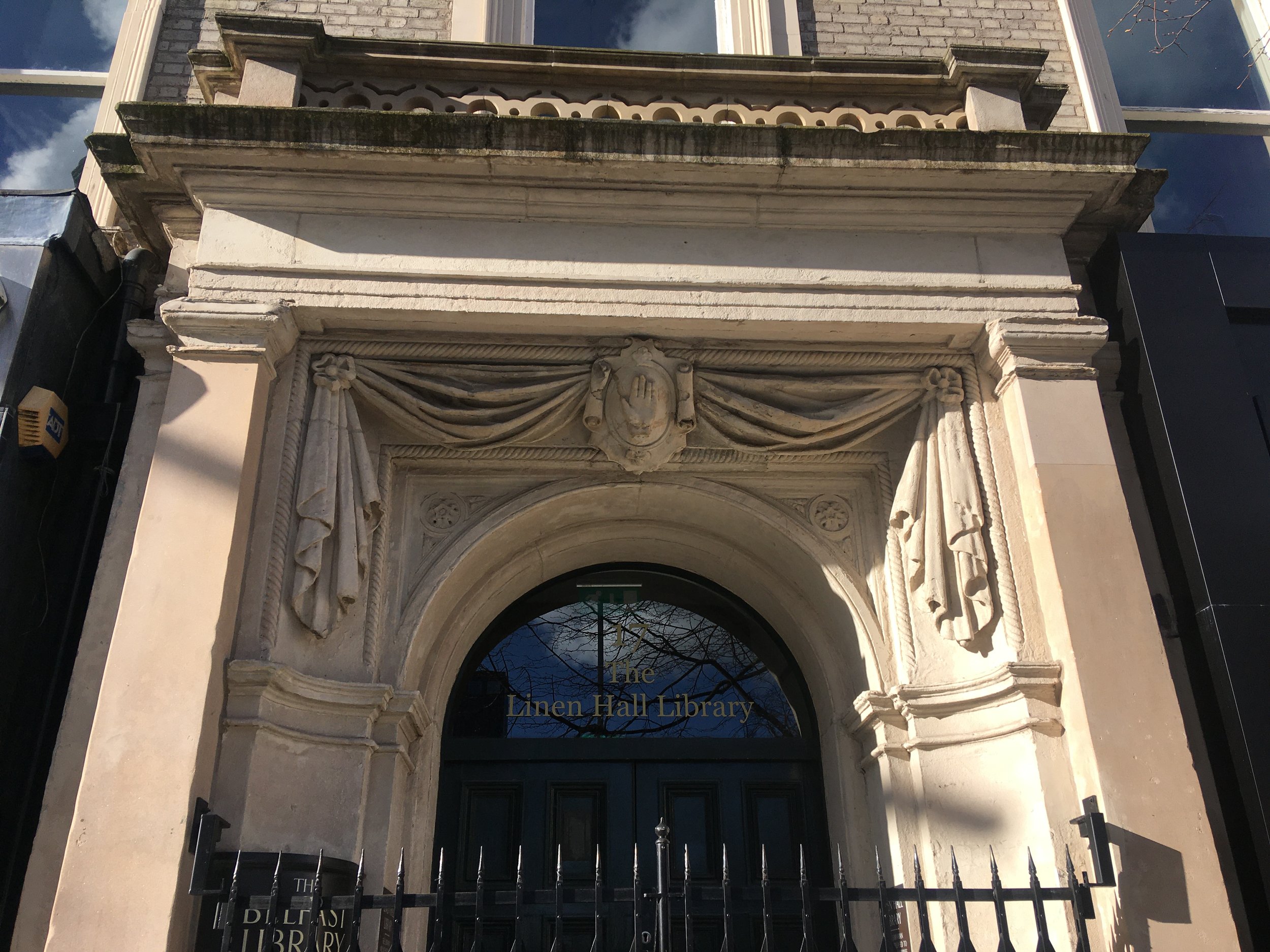
I spent two days in Belfast participating in two sessions there, at the Garrick Pub and the Sunflower Club, and also an afternoon at the Linen Hall Library, researching more about the background to the song, Bonnie Portmore.
On the way from Belfast to Tulla, Co. Clare (for the Robbie’s First Friday singing session) I stopped at the Giant’s Ring, a Neolithic earthen ring with a dolmen or passage tomb in the center. It is estimated to have been built in about 2700 B.C.E., predating the Egyptian pyramids. You can get an idea of its huge size from the satellite image below, right. It’s the almost-perfect circle in the center of the two-mile-wide image from Apple Maps.


I spent a day in Dublin where Luke Kelly is honoured by this statue. I participated in the inspiring mixed singing session called Song Central. Many of the participants are highly accomplished singers of all sorts: blues, gospel, Irish traditional, folk, singer-songwriter. Then I drove to Sligo, passing one of the many sculptures that grace the modern Irish highways.

24 - 27 Mar.
Inishowen International Folk Song and Ballad Seminar
Scores of the best singers—approaching 200—from all over Ireland, Scotland, as well as the UK and America, assembled for the weekend of inspired (and inspiring) singing, with the sessions lasting well into the early morning (the Saturday night session finally broke up at 9:00 Sunday morning for breakfast!). The late night sessions were in the Ballyliffin Hotel, while other events during the day were held in nearby towns at McFeeley’s and The North Pole, among others. It was a thrilling weekend. Unfortunately, it was also a super-spreader and I (among many others) caught covid, me for the first time (in spite of my five shots).


27 Mar. - 3 April
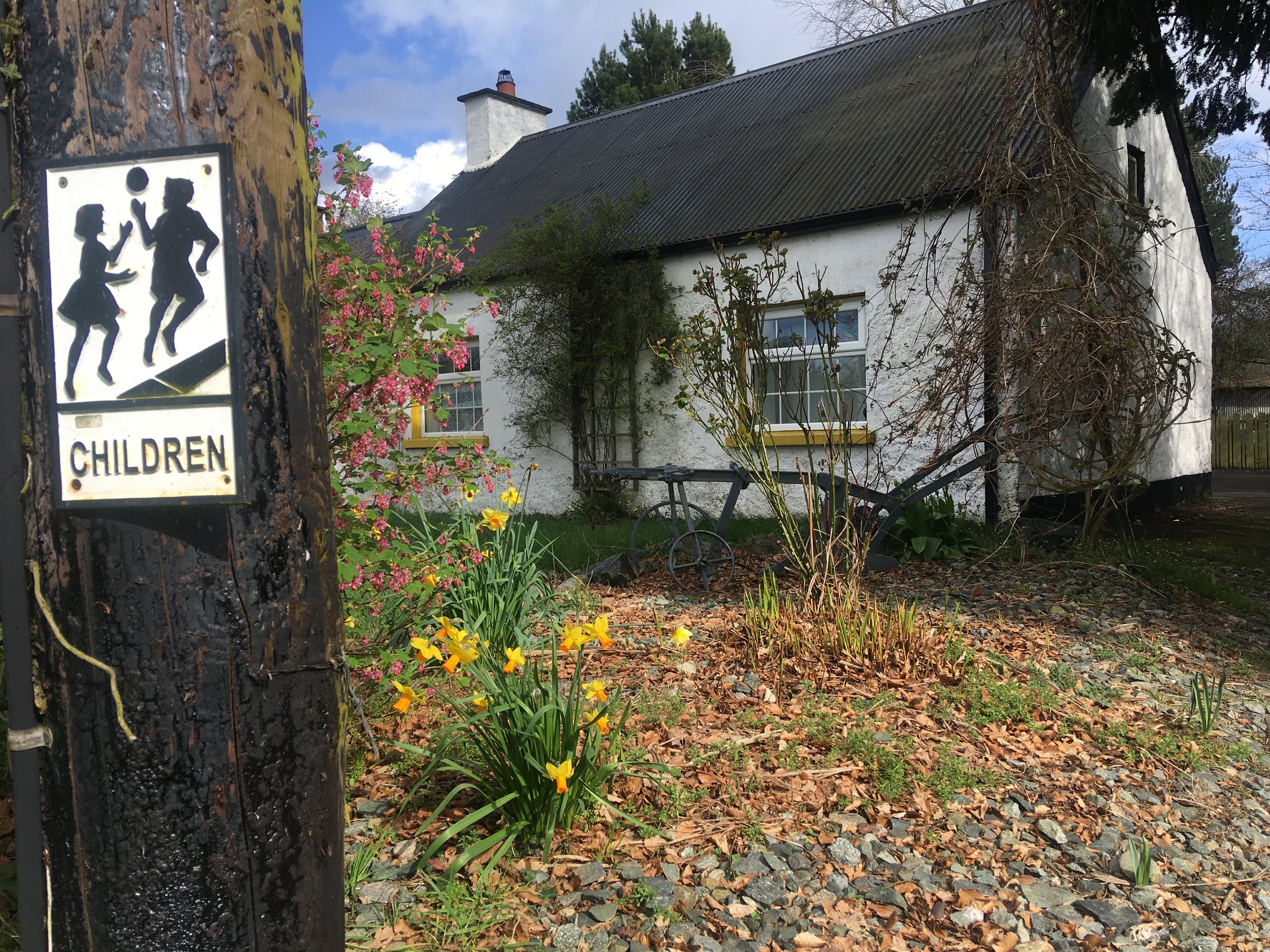
I spent my first night in Ireland in the Lough Shore Cottage, the vacation rental owned by my generous friends Tom and Leone McElhone. Then, after the weekend in Ballyliffin, Co. Donegal, at which I came down with covid, I returned to isolate here in Tom’s great-uncle’s stone cabin, built around 1890. The Land Reform Acts of the late 1880s and early ‘90s allowed the McElhones to return to their ancestral lands which had been taken from them (Catholics) after the Williamite wars of the 1690s had been won by the new Protestant king, William of Orange. The first wave of Irish immigration to the United States was in the mid- to late-1700s. Many of them ended up in the Appalachian Mountains and were called “hillbillies” because of their support for King William.


Notes on my visit to Ireland in 2022
What an inspiring and gratifying visit to Ireland. How lucky I am that I still have the health and means to travel, the voice and memory to sing, the friendship of dozens of singers and others in Ireland, and that I’ve fallen in love with a country that has such a robust tradition of music and singing. Can’t wait to return next year!

All good things must come to an end.
My last Sunday in Ireland I drove to Manorhamilton, Co. Leitrim to attend an inspiring session in the Castle Cafe and led by Rosie Stewart

The Castle Cafe, to the left of and just in front of the ruins of the Manorhamilton Castle, erected in 1634 and burned in 1652 and now a tourist attraction.
I ended my trip—returning a generously lent car—where I began it, in Clonakilty, Co. Cork, where Michael Collins, “The Big Fellow” and one of the main leaders of the war of independence, lived as a child. He was killed in an ambush during the civil war not far from here.
Of singing and mountains, 15 - 21 May
Saturday night was the second hybrid session of our BOSS (Bottle of Stout Singers) session. (BOSS is the rump of the previous two summers’ Góilín sessions, which moved to Saturday and has now been going for almost two years.) We had three people singing harmonies (and solos) in Dublin while the others from six different countries were on Zoom. Great singing session!
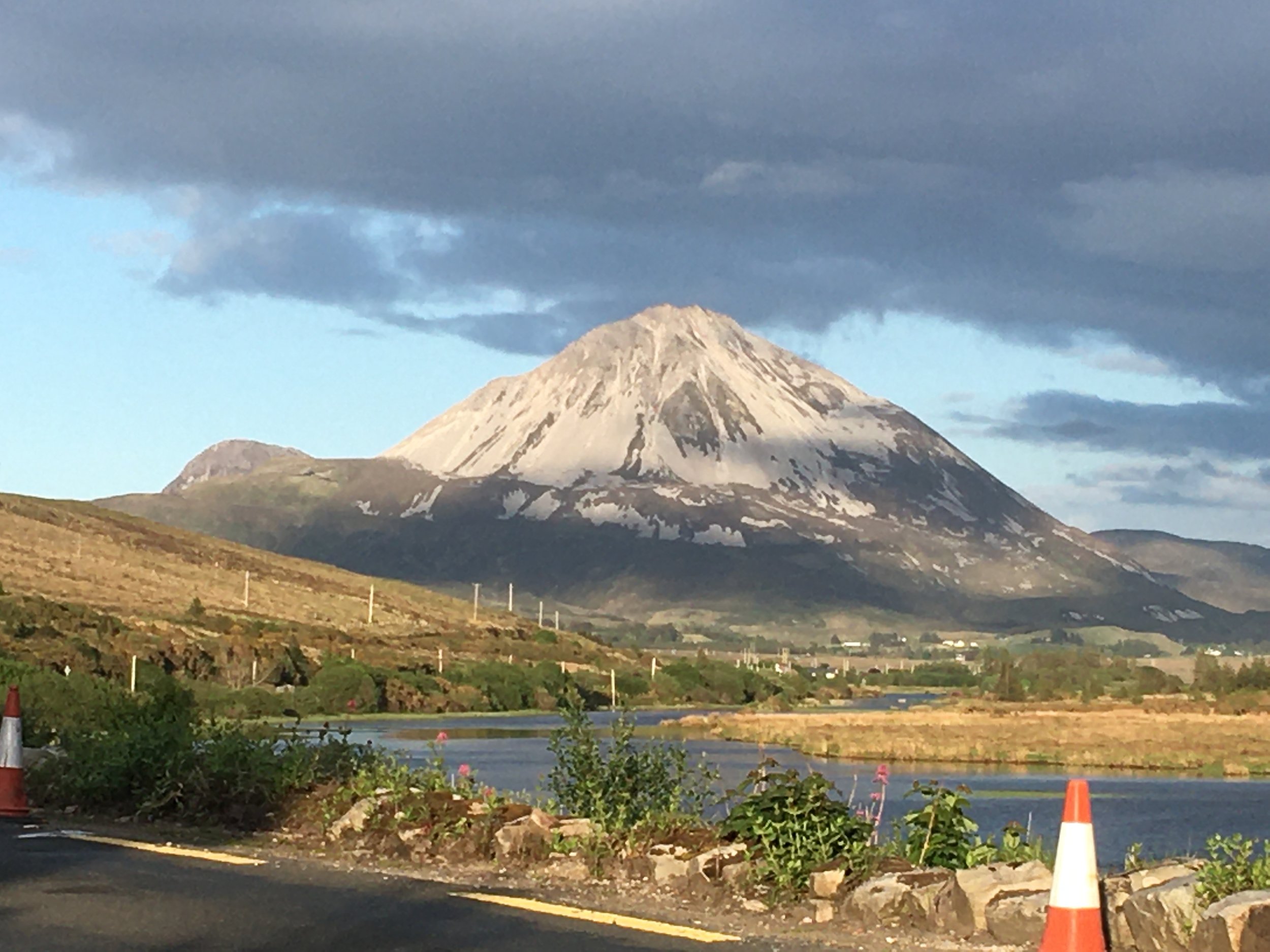
On Tuesday I climbed Errigal, pictured above, a 2500 ft. peak in Donegal. Summited OK despite 30 to 40 MPH winds. At the peak, in a careless moment, I laid my pack down, unsecured, and a huge gust of wind blew it over the steepest edge. I lost a bunch of gear as well as my passport! Fortunately the gear wasn’t necessary to get back down and the staff at the US Consulate in Belfast were amazingly accommodating and I got a new passport two days later with less than four hours of waiting!
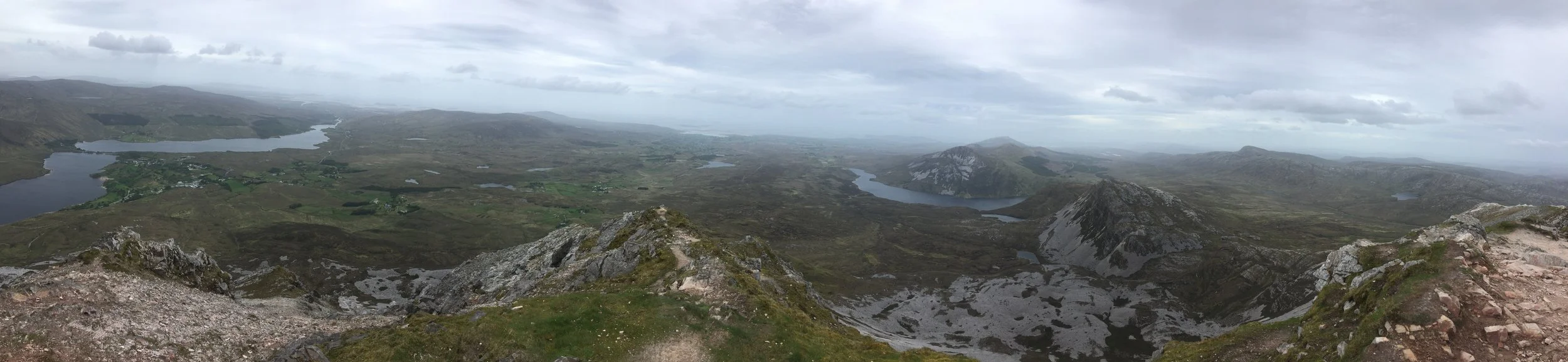
Panorama from the north summit

Panorama from the south summit

I’m on the south summit with the north summit in the background. I’m trying to hold the phone steady in the high winds.
In the West of Ireland, 11 - 13 May
It was good to get out of the city and into the countryside! The lush green fields, often with cattle or sheep, and the blooming whitethorn trees, many in the hedgerows or edges of fields and the occasional one left, by tradition, in the middle of a field, all have a beauty and allure that I don’t seem to find anywhere other than in Ireland. And the music has been great!

The workmanship—well, artistry—of whoever trimmed this 12-foot-tall hedge was so impeccable that I had to share it. Amazing! It was on the grounds of the Church of the Sacred Heart and St. Joseph in Coolaney, where my lodgings were that Wednesday night.

Thursday night I spent in Tigh Mholly (pronounced Tea Wally) in Inverin, Co. Galway, at an inspiring mixed session of tunes and songs, conducted mostly in Irish and bursting with energy, dripping with pathos, and crackling with humour. Great craic! I was honoured to be the guest of the Irish national singing champion of 2016, Caitlín Ní Chualáin and her family.
Dublin, 5 - 10 May
Even though Dublin is said to be the least Irish part of Ireland, it is, in practice, the center of many of the Irish cultural practices, traditional, popular, and classical.

One of my favorite singing sessions is An Góilín in Dublin where I was honored to sing their “three in a row” spot during the session Friday evening.
The Song Central session, on Sunday evening, is always a satisfying mix of traditional and contemporary songs.
I spent several hours at the Irish Traditional Music Archive searching for some rare recordings of keening and the ancient Ossianic Lays.
The staff at ITMA are eminently knowledgeable and helpful!

Belfast, 2 - 4 May
A good time in Belfast attending one traditional singing session at the Garrick Pub (I forgot to take a photo of the facade) and doing some research at the LinenHall Library.

I did get a shot of the Belfast City Hall, a Victorian building in the Baroque Revival style, completed in 1906. It’s just across the street from the Linen Hall Library.
29 April - 2 May: The Joe Heaney Festival (Féile Joe Éinniú) in Carna, Co. Galway.
I attended the Féile Joe Éinniú (Joe Heaney Festival) in Carna, Co. Galway over the May bank holiday weekend. As far as music festivals in Ireland go, it’s a small one, but packed with a huge amount of talent and cultural memory.
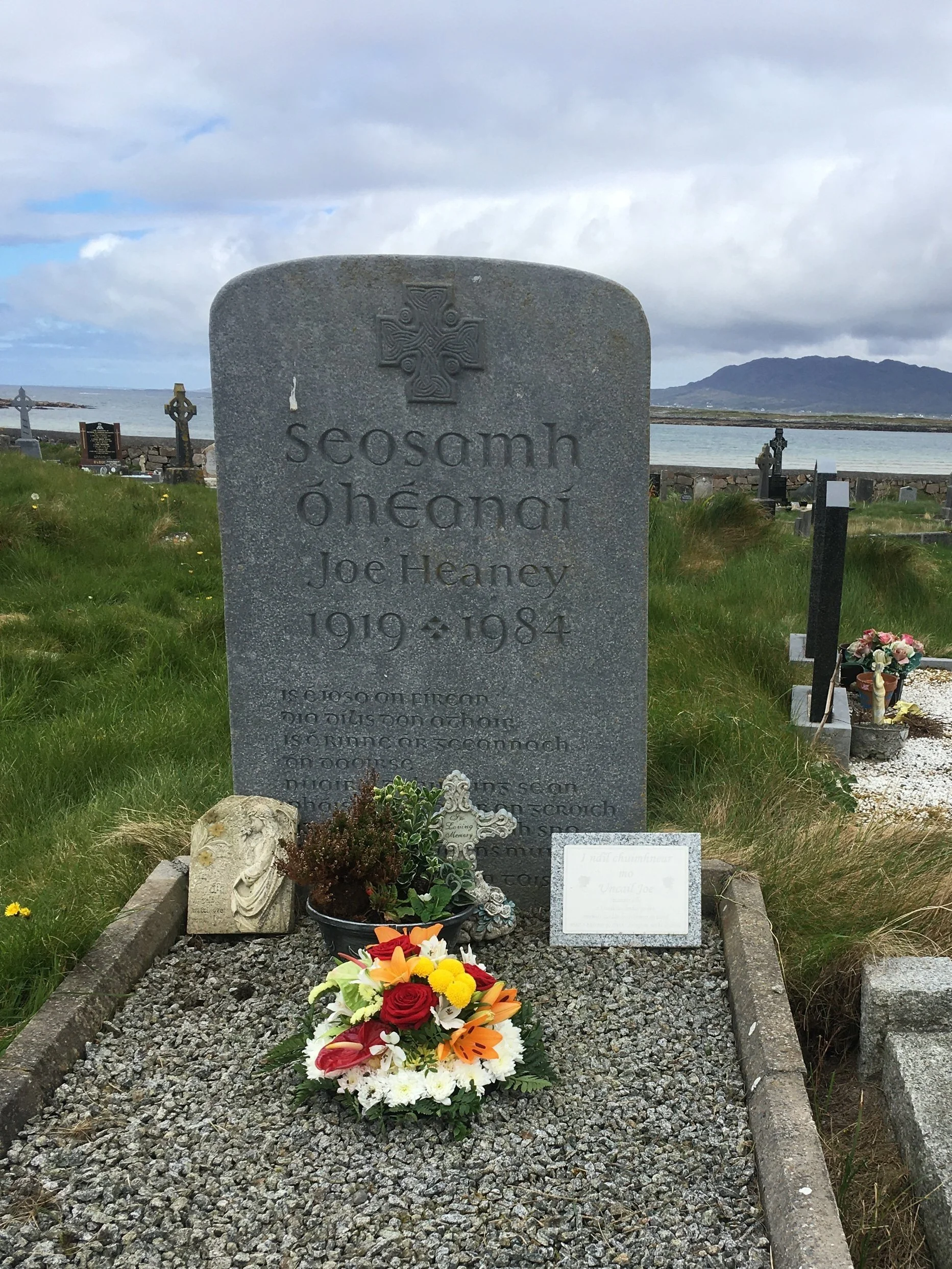
Joe Heaney’s headstone in the Moyrus cemetery.
Many of us visited Joe’s grave in the Moyrus cemetery, about four miles away.

I stayed at Sonas B&B. Lovely accommodations. (Sonas means happiness or good fortune in Irish.)
There were several other singing sessions with many local and visiting singers. I was asked to sing three other times—a thrill and privilege.
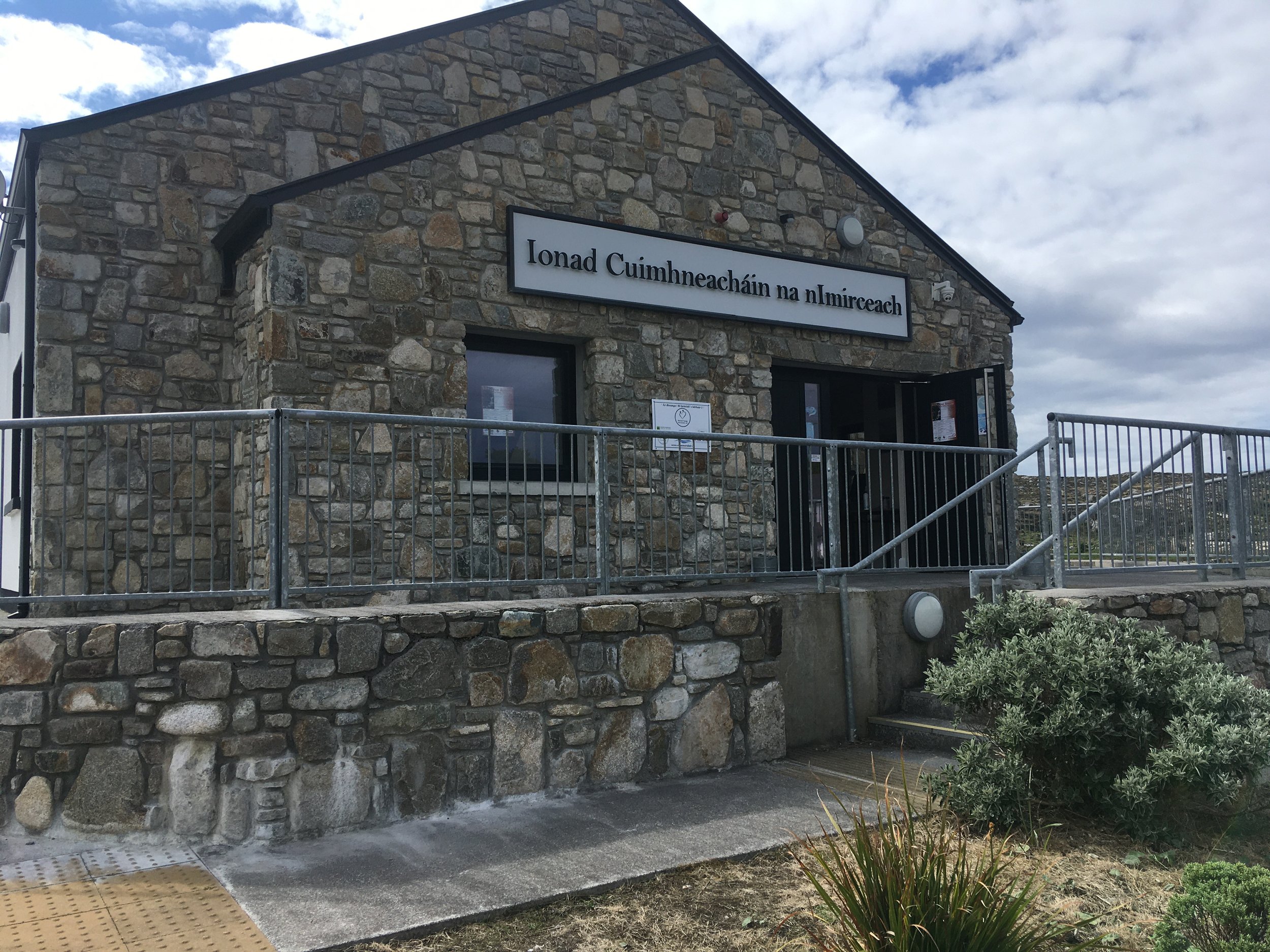
Many of the events were held in the Carna Community Center.
Two stories emerged from this trip. The first is that I was deeply honoured to have been invited to sing traditional Irish songs to Irish singers. Two respected folk singing clubs invited me to be their guest artist. I am profoundly flattered to be so recognized. The second is more prosaic. It can be found in the section below, titled “Of Singing and Mountains.”

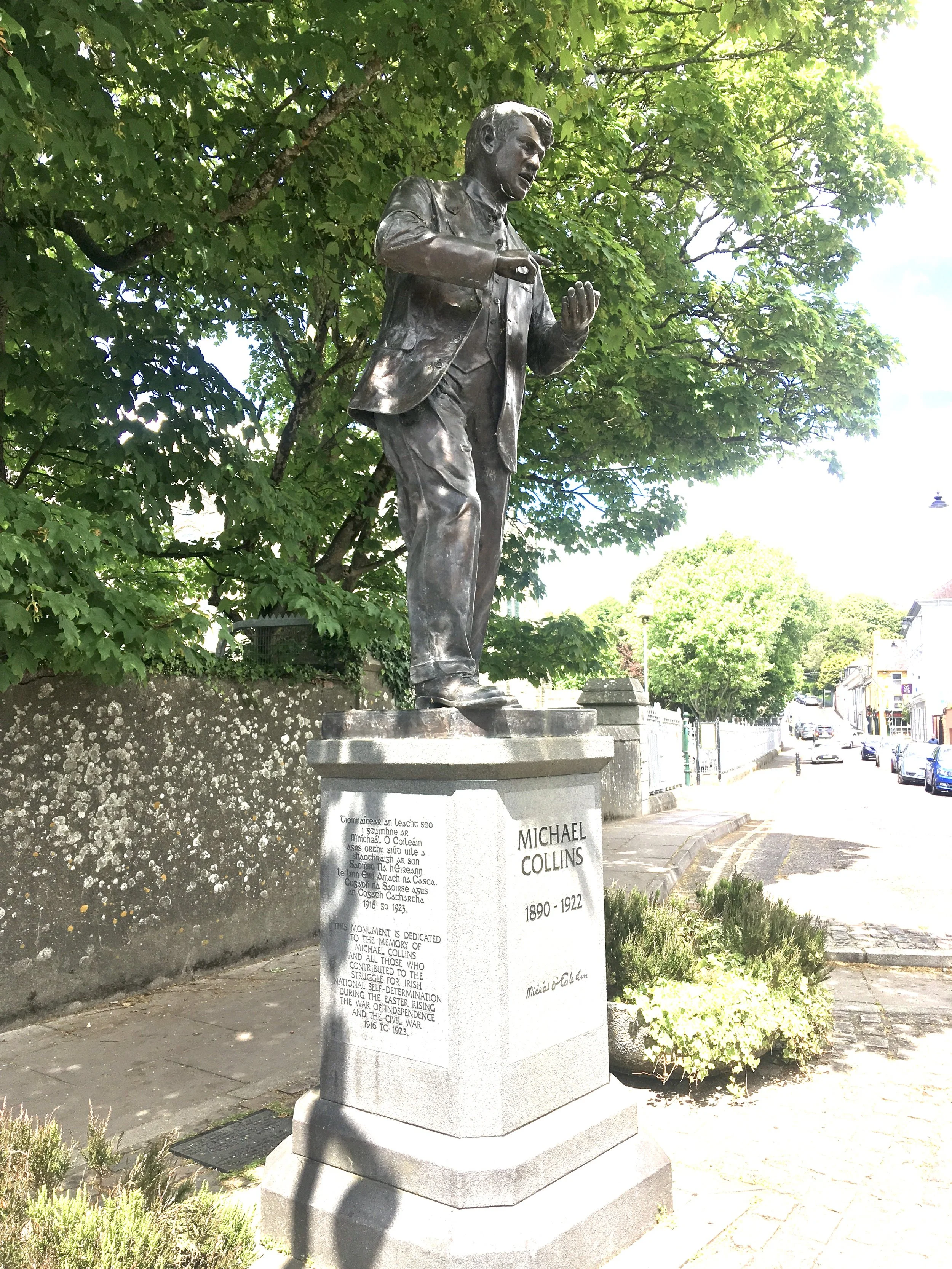
A statue of Michael Collins in Clonakilty.
On Sunday I was at An Spáilpín Fánach (literally the wandering laborer but carrying many layers of cultural and historical meaning) where the Cork Singers’ Club meets every Sunday evening. I had the privilege of being their guest artist the other day and ended up singing ten songs for them. I also chanced to meet the son of a man I collected songs from 40 years ago! Small world!

Wednesday evening session at the Shamrock in Falcarragh.

Thursday evening I was the guest artist at the Sunflower Folk Club in Belfast. I sang and told stories about collecting songs in Ireland for 50 minutes. The audience and I both felt very good about the show!

The Sunflower is, I believe, the only establishment in Belfast that still has their bomb-proof entry cage left over from the troubles.
I spent Friday and Saturday out on Arranmore Island off the coast of Donegal at the Féile Róise Rua, a festival named in honor of the local singer. What a thrilling weekend it was with singing until almost 3:00 a.m. Saturday night. A fair bit of the singing was in Irish and I got to practice my language skills a lot.


Durkin’s Pub in Ballinacarrow, Co. Sligo, where we had a rousing singing session on Wednesday night with luminaries Vince Hearns and Rosie Stewart present.

Also on the grounds of that same church—actually in front of what appeared to be the priest’s residence—was this startling tree arrangement. I couldn’t help but wonder if there was some subconscious motivation, maybe from the early Irish Christian church in which priests were allowed to marry!

Friday night I was at the session in Ballinamore Bridge in east Co. Galway at Hughes’ Pub, now under the third generation of the Hughes’ family management. I was the guest of singer and collector Declan Coyne and his wife, Teresa.
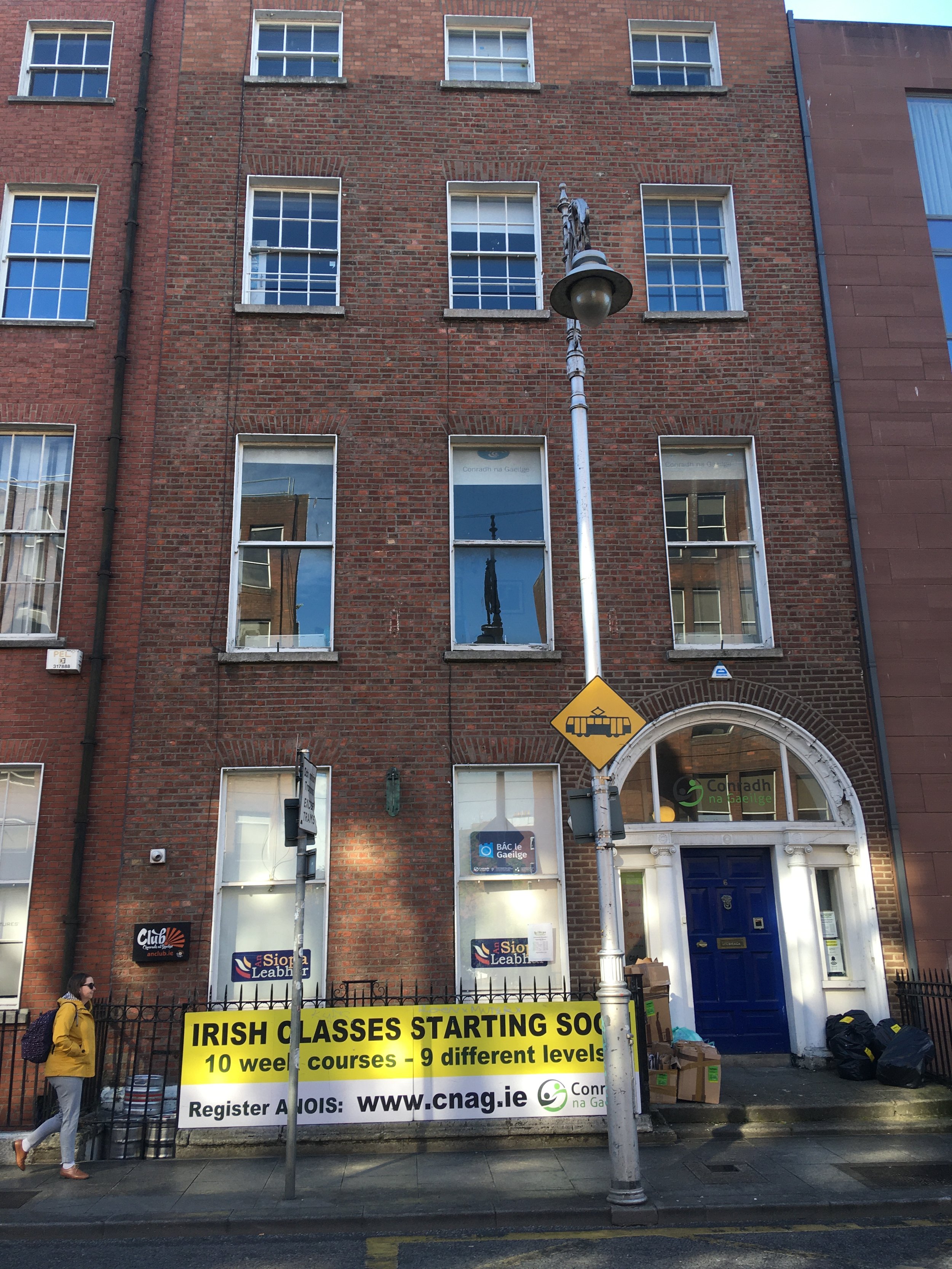
Thursday evening session at Conradh na Gaeilge, the Irish language organization. The session was all in the Irish language so I could understand only bits and pieces of the conversation, but I recognized all the songs and sang two of my own songs as Gaeilge.

On Saturday afternoon at the Moore Street Market you’ll always find Diarmuid Breatnach at his table of literature and petitions to save the Moore Street buildings from demolition and redevelopment. https://www.facebook.com/diarmuid.breatnach These buildings were among the most important in the Rising of 1916 and developers want to tear them down to build stores and hotels so they can make more money. I’m standing before the Irish tri-color and the starry plow, the flag of the Irish Citizen Army, which was among the main factors in the 1916 Rising.

I always stop in at my favorite bookstore in Dublin, Hodges and Figgis.
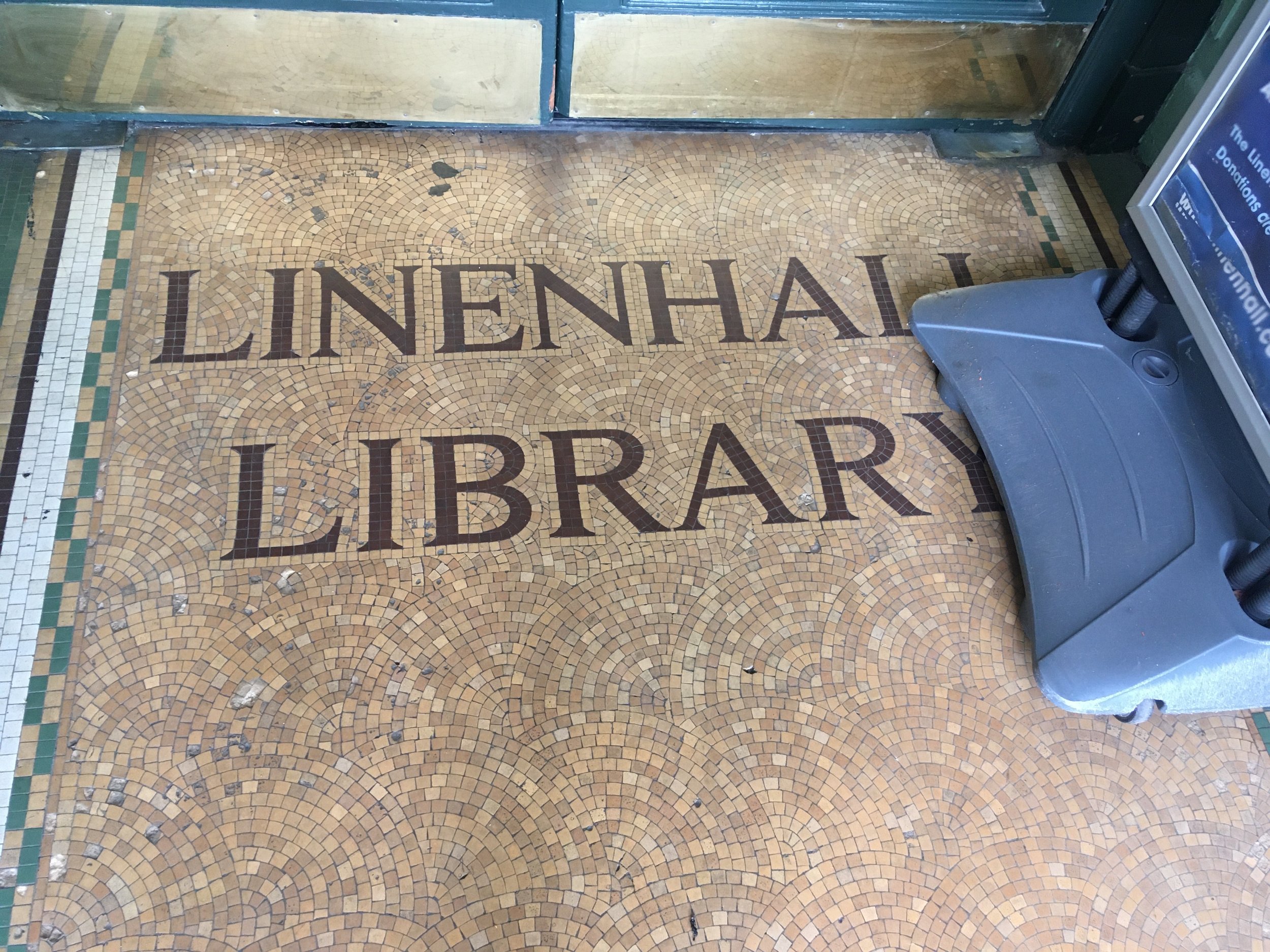
The mosaic entryway to the Linen Hall Library, a major research center in the north of Ireland. The facade was covered with scaffolding so I took this shot instead.
I met a friend at the Linen Hall Library cafe then did some computer work—email, website, etc. On the way out I thought I’d ask the reference librarian for a bit of research advice about the subject of the song, Bonnie Portmore. I’d already done a fair bit of research but would like to do more (see my blog about it HERE). At that point a man came up beside me and said that he might be able to help. He is a local historian with loads of connections and resources not to mention information! Delightful serendipity!
Most of the sessions were held in Moran’s Pub.
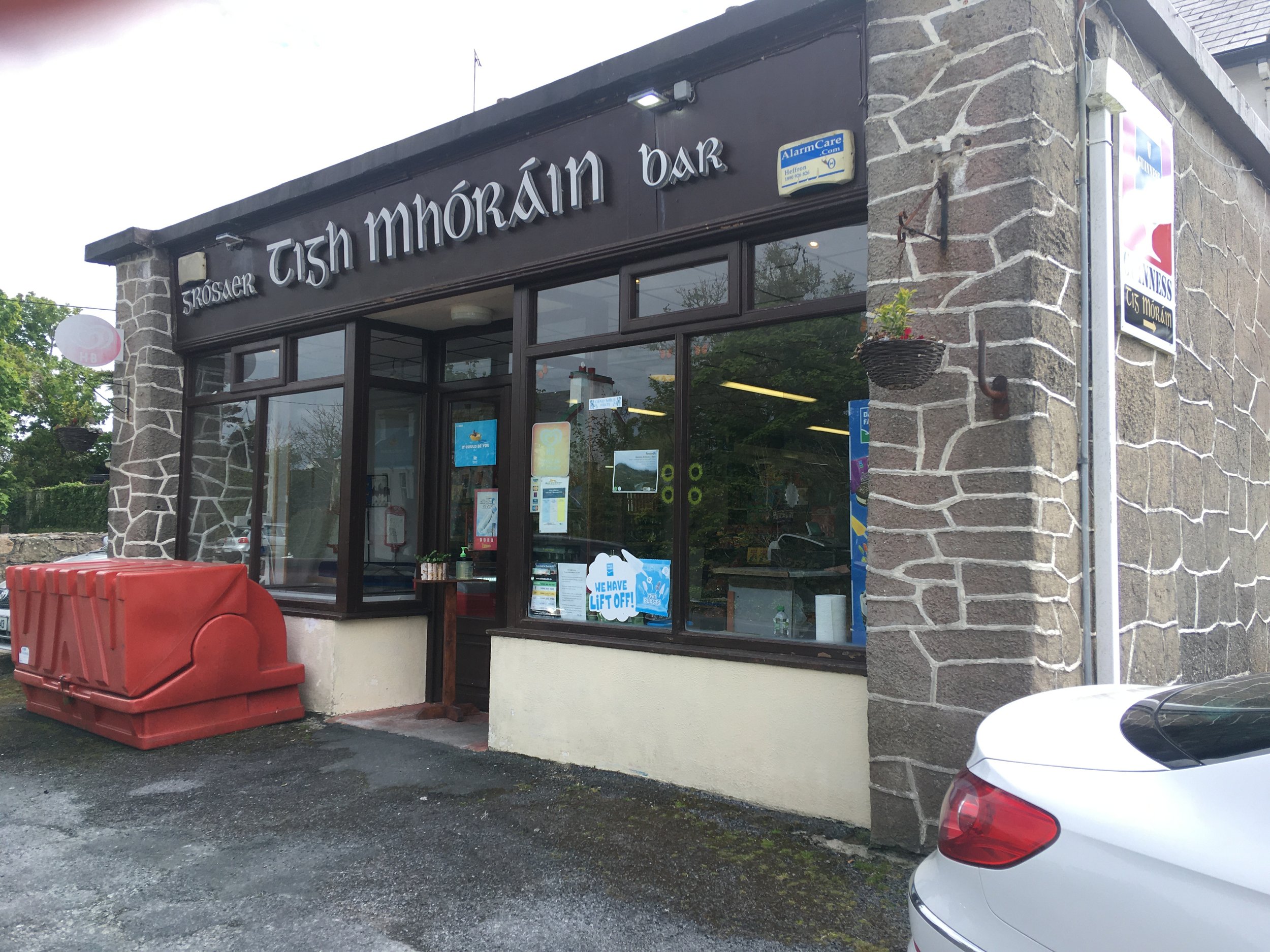
This is actually Moran’s shop, just in front of the pub, but the only place where the name “Moran” is prominent.
At the introductory session I had the honour of being asked to sing. I sang Raghadsa ‘s mo Cheaití, my newest (and best) song in Irish.

Josie Sheain Jeaic, another notable singer and neighbor of Joe Heaney, is buried nearby. I was fortunate to be in a number of sessions with him the last time I was in Carna. He died five years ago.
The book, Colm Ó Caodháin, by Ríonach Uí Ógáin, was launched. And Sarah Ghriallais launched her newest CD. There was also a lecture on the Connemara Pony. Everything was in the Irish language so I was able to understand only a word or two here and there.

A mighty céili was held at the Glynsk House with great music, dancing (both sets and solo step and sean-nós dancing), and singing. Great craic!